Table of Contents
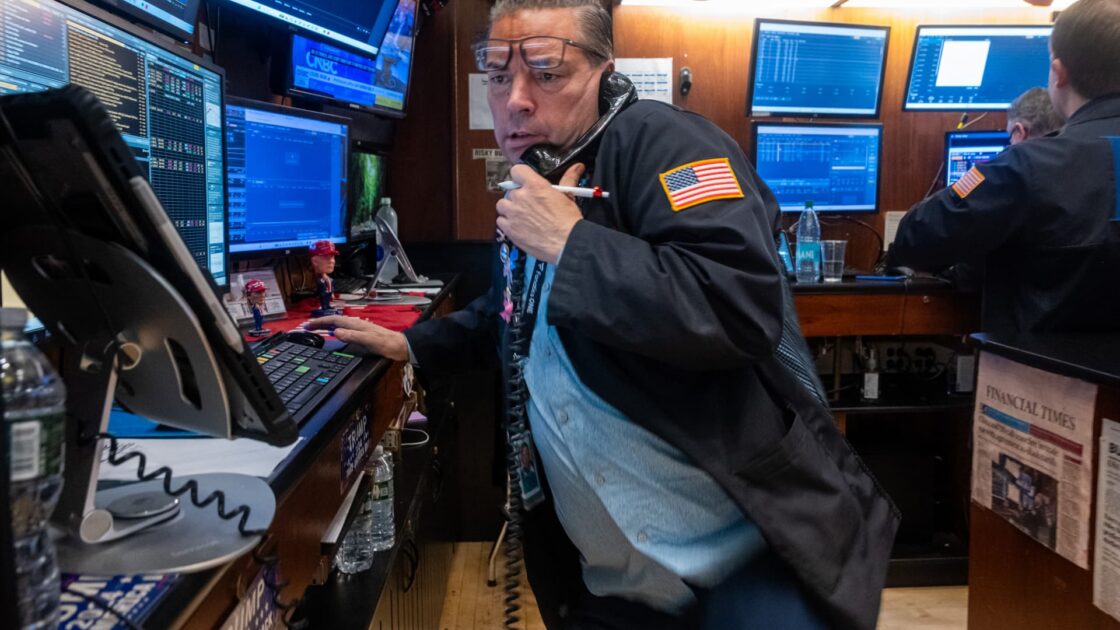
The Nasdaq Composite declined on Friday, pushing the tech-heavy index into negative territory for 2026. The downturn persisted despite the high-profile initial public offering (IPO) of AI firm Anthropic and ongoing activity surrounding Nvidia, as investors continued to retreat from the artificial intelligence sector.
Global Market Sell-Off
The sell-off extended across global markets, with Asia-Pacific indices suffering significant losses. Japan’s Nikkei 225 plunged 5.06%, while South Korea’s Kospi sank 5.21%. In Taiwan, the Taiex benchmark recorded its steepest weekly decline since October 1997, falling 14.89% over the week. European markets also opened lower, with the Stoxx 600 dropping 0.83% and regional technology stocks falling 2.7%.
Bénédicte Lowe, an equity derivatives strategist at BNP Paribas, told CNBC that the market is experiencing a “mind-boggling” disconnect where a broad sell-off coincides with a record-breaking IPO. She noted that investors are engaging in “panic selling” to determine if AI sentiment has peaked, adding that “no market can weather a proper unwind of the tech trade.”
Tech Sector and Anthropic Performance
Anthropic shares fell more than 9% on Friday, one day after the company’s historic Wall Street debut. While the stock rallied 17% on Thursday, it closed well below its session highs. Seaport Research initiated coverage on the stock with a neutral rating, with analyst Jay Goldberg stating that while the company is impressive, it requires an “incredible leap of faith” from investors.
Other major technology companies also faced pressure. Nvidia shares slipped, reaching their lowest level in over a year. Additionally, California Attorney General Rob Bonta issued an investigative subpoena to Nvidia to determine if the company’s advanced chips were sent to China or if the firm misled investors regarding such risks. Other “Mag 7” stocks, including Alphabet, Meta, Microsoft, Amazon, and Tesla, also traded lower.
Economic Indicators and Investor Sentiment
The CBOE Volatility Index (VIX), often referred to as Wall Street’s “fear gauge,” rose above 30 on Friday morning, reaching its highest level since March. Amid the equity decline, investors moved toward safe-haven assets, causing U.S. Treasury yields to fall. The 10-year Treasury yield dropped 6 basis points to 4.989%.
Despite the market volatility, a University of Michigan survey indicated that consumer sentiment improved in November, with the headline index rising 7.3% to 51.5. Inflation expectations at the one-year horizon also declined sharply to 3.7%, the lowest reading since March. However, survey director Joanne Hsu noted that consumers still report that inflation is likely to cause more hardship than unemployment over the next two years.
Corporate Developments
Several companies reported earnings or outlooks that impacted trading. Intuit shares slid approximately 8% after the company lowered its fiscal 2027 revenue forecast, citing a slowdown at Credit Karma. Ross Stores fell 5% following a disappointing forecast, while French video game publisher Ubisoft dropped 13.2% after providing a weaker-than-expected outlook for the holiday quarter.
In Asia, Samsung Electronics announced a leadership reshuffle, appointing new heads for its semiconductor and mobile businesses. Meanwhile, Alibaba shares rose 2.42% following a quarterly report that showed operating income surging 443% year-over-year.
Future Outlook
James Reilly, a senior markets economist at Capital Economics, suggested that the pressure on technology stocks and the S&P 500 may continue. He projected that the S&P 500 could fall to 6,500 by the end of next year. Conversely, Brett Winton of ARK Investment Management argued that there is “a lot of upside” for AI stocks, asserting that the market is in the early stages of a dynamic shift in the knowledge workforce.
Spot gold prices fell 2.81% to $3,520.05 per ounce on Friday, putting the metal on track for its worst weekly decline in eight months as the U.S. dollar strengthened and expectations for a Federal Reserve interest rate hike in December grew.