Table of Contents
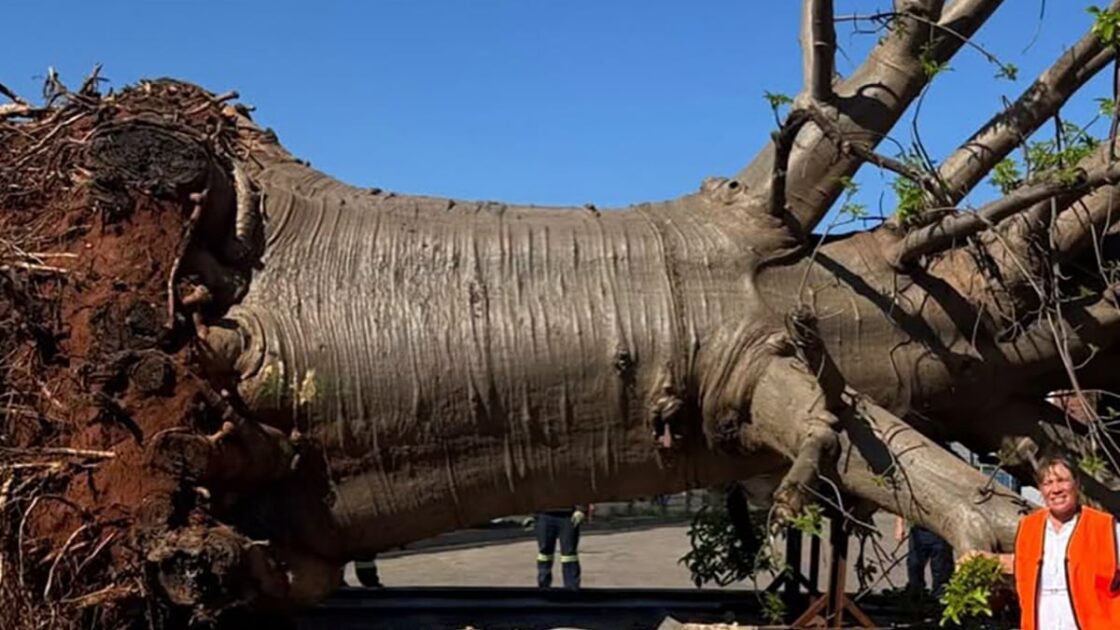
Environmentalists in South Africa are working to replant five centuries-old baobab trees after they were illegally uprooted for export. The 20-tonne trees, which were destined for an unnamed buyer in Georgia, were intercepted by authorities in July and held in a Durban warehouse before being moved to a reserve in Timbavati this week.
A Complex Rescue Operation
The Department of Forestry, Fisheries and the Environment confirmed that the trees were being transported without the required permits. The rescue mission to return the trees to the ground has been logistically challenging, as the baobabs weigh between 19 and 29 tonnes, reach heights of up to 12.5 metres, and have diameters of up to 4.5 metres. These massive specimens require specialized trucks capable of carrying abnormal loads.
Sarah Venter, founder of the Baobab Foundation, who is leading the replanting efforts, stated that the trees have a strong chance of survival if they are established quickly. She noted that the current timing is critical, as the trees must be in the ground before the spring season begins in November, when they begin using their water reserves to produce new leaves.
Once replanted, the trees will be secured with cables for stability and protected by electric fencing to prevent damage from elephants. Because baobabs possess shallow root systems, they do not require deep planting and can regenerate their roots relatively quickly, according to Venter. The trees are estimated to be between 200 and 300 years old, with the potential to live for over a millennium.
Ecological and Cultural Significance
Baobabs are protected under South African law, requiring official permits for any disturbance. Landscape designer and horticulturist Wambui Ippolito described the trees as “biodiversity anchors,” explaining that they function as entire ecosystems. Their cavities provide shelter for various species, including bats, bush babies, grey-headed parrots, and southern ground hornbills, while their fruit serves as a food source for elephants, monkeys, and warthogs.
Beyond their biological role, the trees hold immense cultural value across the continent. “It has always been a sacred tree in Africa,” Ippolito told The Guardian. “Somebody’s great-great-great-great-great-grandparents sat under that tree, and it is part of human history in that area.”
Context of the Illegal Trade
Experts note that the international trade of baobabs as ornamental plants is highly unusual due to the extreme difficulty of extracting, transporting, and successfully re-establishing such large trees. David Newton, programme office director for east and southern Africa for the NGO Traffic, described the practice as rare.
The situation mirrors a 2019 incident in Kenya, where eight baobabs were uprooted for export to a private park in Georgia owned by billionaire Bidzina Ivanishvili. While environmentalists initially blocked that export by labeling it “biopiracy,” the trees were eventually moved.
Authorities have initiated a criminal case against the owner of a landscaping company alleged to be responsible for the illegal harvesting and transport of the South African trees.