Table of Contents
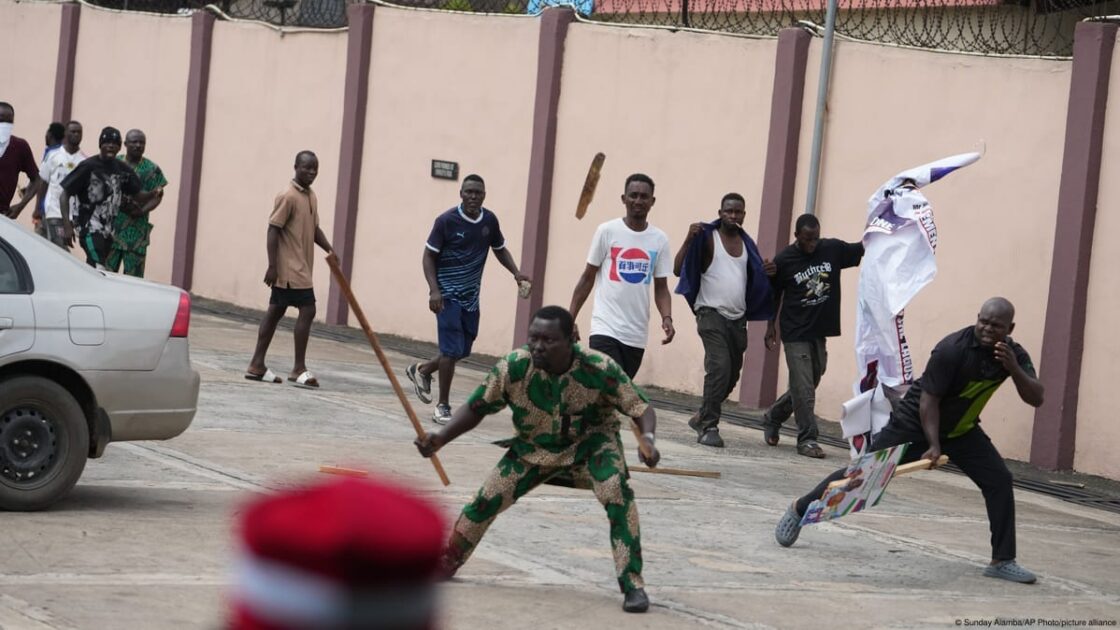
Journalist Samuel Adebanjo was covering a town hall meeting in Lagos organized by the opposition National Democratic Congress (NDC) when a group of armed men suddenly stormed the venue and disrupted the gathering. Equipped with axes, cutlasses, and wooden planks, the attackers targeted party supporters and pursued Adebanjo, breaking his middle finger and damaging his equipment before he managed to reach safety.
Election-related violence on the rise
As the January 16, 2027 general election approaches, incumbent President Bola Tinubu faces re-election while battling insecurity and an economic crisis, but election-related incidents are becoming increasingly common. The National Peace Committee has recorded 109 breaches of the National Peace Accord across 26 states and Abuja. Between the campaign kickoff on August 19 and October 27, political violence, thuggery, misinformation, and disinformation topped the violations with 33 and 29 incidents respectively.
Similar attacks have targeted campaign events in Kano, Sokoto, and Kebbi. Civil society organizations, including Amnesty International, have strongly condemned the violence and urged authorities to hold perpetrators accountable. President Tinubu has also denounced the growing unrest, warning that political thuggery and intimidation will not be tolerated.
Nigeria’s history of electoral violence
Political unrest has long tainted Nigerian elections, including the 2011 post-election riots that resulted in at least 800 deaths across northern states. Raheem Mutiu, a researcher at the Armed Conflict Location & Event Data (ACLED), told Deutsche Welle (DW) that the current pattern shows political groups determined to secure victory by any means necessary. Mutiu noted that within two months, researchers recorded over 30 politically linked attacks resulting in 10 fatalities, with the violence becoming more frequent and geographically widespread.
Mutiu explained that Nigeria’s multiparty system encourages a winner-takes-all mentality and fierce competition, alongside growing intolerance toward opposition groups. Perpetrators often operate anonymously as proxies, with the intensity of their violence varying based on territorial dominance across the political spectrum.
The high cost of violence
Dengiyefa Angalapu, a researcher at the Abuja-based Center for Democracy and Development, told DW that a voter making a choice under threat cannot vote freely. Angalapu warned that physical attacks, fake news, and hate speech deceive voters, undermine trust, and threaten voter participation. Nigeria already suffers from low voter turnout, with the 2023 elections seeing only 27% of nearly 94 million registered voters casting ballots, despite over 103 million citizens being registered for the 2027 vote.
Adebanjo is still recovering from his injuries and questioning public safety as the election draws near. He expressed concern that if violence can happen to a journalist, ordinary citizens will be too afraid to come out and vote.