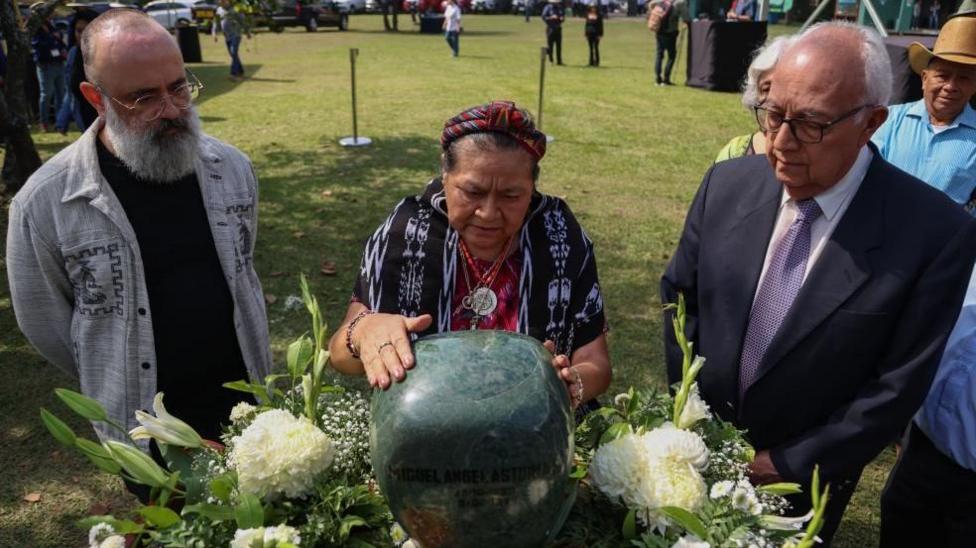
The remains of writer and diplomat Miguel Ángel Asturias have been buried in his native Guatemala 52 years after he passed away in exile. His ashes were transported to Guatemala from Paris, following his death from cancer in Madrid in 1974.
Return and Burial Ceremony
The urn holding his ashes was interred in soil collected from various regions of Guatemala at a cultural centre named in his honor located in Guatemala City. During the ceremony on Sunday, his son, who shares his name, addressed the late author by saying, “I can tell you, old man, that you are with us, you are in your homeland, you will sleep beneath your own skies.”
His son noted that the writer had always desired to return to Guatemala, but prevailing political conditions prevented him from doing so. The family consented to transfer the ashes from the Père Lachaise cemetery in Paris only after the election of Guatemala’s current progressive president, Bernardo Arévalo, in 2023.
President Arévalo commended Asturias during the interment ceremony, describing him as the nation’s voice globally. Arévalo stated that the author deserved to rest in the land he named and reinvented in his pages. Arévalo’s own father, Juan José Arévalo, had previously appointed Asturias to the diplomatic service during his presidency.
Literary Career and Exile
Born in 1899, Asturias relocated to Paris in the 1920s to study ethnology. Shaped by surrealism, he produced his initial major work, Legends of Guatemala, which retells Maya origin legends and mythological tales, while living in France. He received the Nobel Prize for Literature in 1967 for his descriptive writings that incorporated the experiences of indigenous Guatemalans.
Later writings, including the 1946 novel The President and his Banana Trilogy, criticized dictatorship horrors in Latin America and the mistreatment of indigenous workers on banana plantations. His widely recognized novel, Men of Maize, was released in 1949 and addresses the challenges faced by indigenous communities amid rapid modernization.
Asturias held several diplomatic positions in Central and South America during a reformist era from 1944 to 1954, continuing his writing alongside his duties. However, following the overthrow of democratically elected President Jacobo Árbenz Guzmán in a CIA-backed coup in 1954, Asturias lost his citizenship, faced a ban on his books, and was forced into exile.