Table of Contents
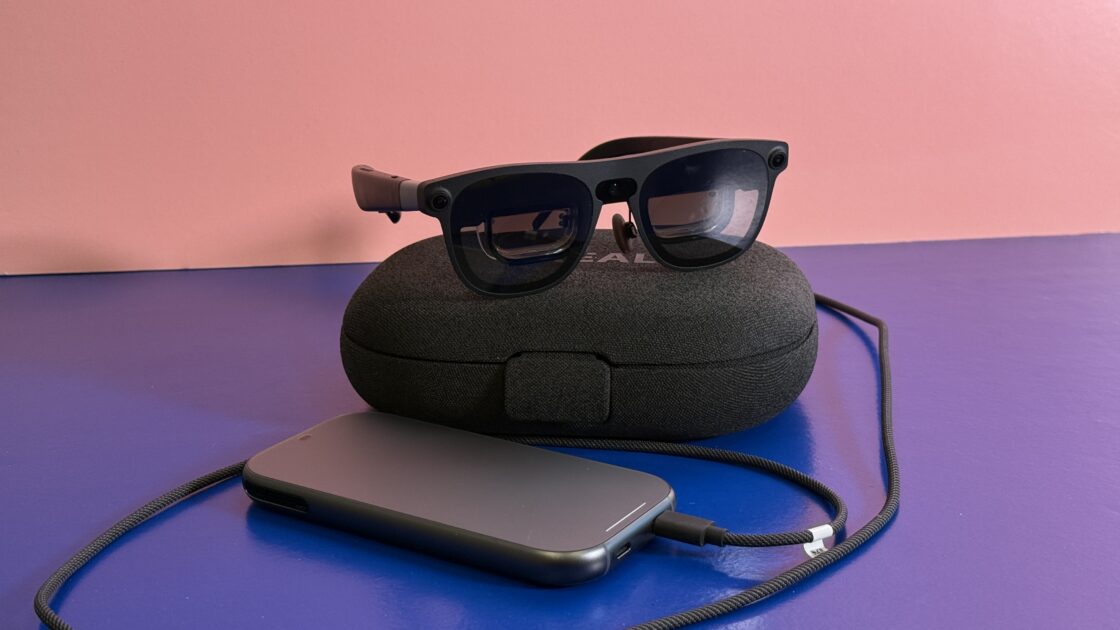
The Xreal Aura, a new collaboration between Google and Xreal, occupies a unique space between traditional VR headsets and smart glasses. As reported by CNET, the device functions as a portable, Android-powered system that allows users to project multiple virtual displays and run immersive applications on the go.
Design and Display Capabilities
The Aura features twin micro-OLED displays that use “birdbath” prism technology to project images into the user’s field of view. While the lenses are somewhat bulky compared to standard eyewear, they offer a 70-degree field of view, which exceeds that of many previous AR glasses. The display supports up to 120Hz refresh rates and a resolution of 1,920×1,200 pixels per eye, providing a crisp experience for watching movies or viewing virtual monitors.
The device connects via a USB-C cable to a processor puck that runs Android XR, an operating system designed by Google for augmented and virtual reality. This puck houses a Qualcomm Snapdragon Reality Elite chip, which handles multiple 2D and 3D applications simultaneously. The entire kit is designed for portability, fitting into a case smaller than one used for a Nintendo Switch 2.
Controls and User Experience
Navigation on the Aura relies on a combination of hand tracking, a built-in touchpad on the processor puck, and voice commands via Google’s Gemini AI. According to CNET, hand tracking allows users to pinch and tap to interact with virtual windows, though the experience can feel limited by the glasses’ field of view. When a user’s hands move into their peripheral vision, the system sometimes struggles to track them accurately.
The device also lacks eye tracking, a feature found in competitors like the Apple Vision Pro or Samsung Galaxy XR. Consequently, users must lift their hands to interact with the interface, which can become tiring. The processor puck includes a fingerprint sensor for security and volume controls, though the device can generate significant heat. CNET noted that the puck should not be kept in a pocket, as it requires airflow for its cooling fans.
Integration and AI Features
A standout feature of the Aura is its deep integration with Gemini. By pressing a button on the glasses, users can launch the AI assistant to perform tasks like dictation or visual analysis. When a user shares their camera feed, Gemini can describe the environment, read text, or assist with “circle-to-search” functionality to identify objects in the real world or on virtual screens.
The Aura also functions as a display for other hardware. By using a DisplayPort-ready USB-C cable, users can connect devices such as a MacBook, iPad Mini, or Nintendo Switch 2 to project a virtual monitor. While this allows for a multi-screen workspace, CNET pointed out that managing peripherals—such as using a separate keyboard for the glasses versus the connected device—remains a significant hurdle for seamless multitasking.
Pricing and Availability
The Xreal Aura is priced at $1,279 for the 256GB storage model and $1,499 for the 512GB version. Both models are currently on sale for $1,099 and $1,299, respectively, through the end of the year. The device does not feature an expandable microSD card slot, meaning users are limited to the onboard storage capacity.
While the Aura offers a glimpse into a future of portable, high-powered AR, CNET concluded that the software and input methods remain in an early, experimental stage. The device is expected to accompany the reviewer on future trips, serving as a functional, if occasionally frustrating, tool for mobile productivity and entertainment.