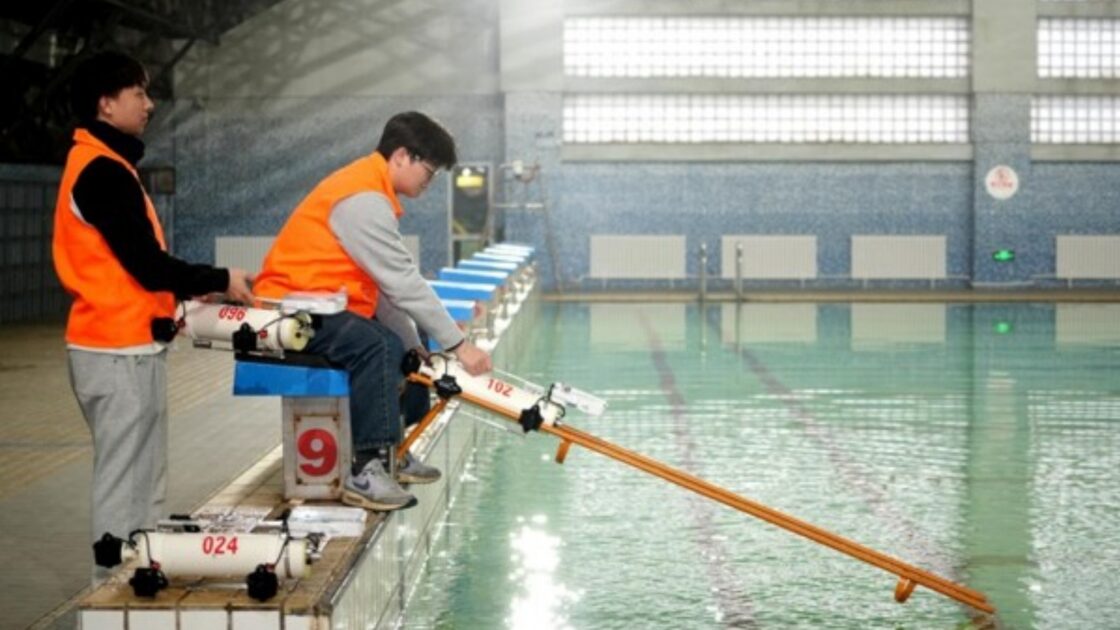
Researchers in China have set a Guinness World Record for the largest swarm of underwater drones in history, deploying 116 autonomous devices in a pool to execute complex formations. The August 2026 test was conducted by Northwestern Polytechnical University alongside Xi’an Tianhe Maritime Technologies, a subsidiary of a defense contractor, with strong ties to China’s military development pipeline.
Under the Sea
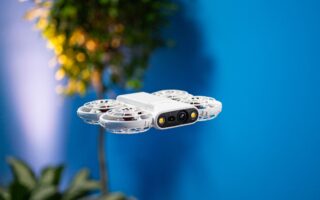
The trial utilized TH-618 drones, which measure roughly two feet long and half a foot wide, weigh 11 pounds, and feature four propellers, a camera, and a range of over 18 miles with an eight-hour operating capacity. To navigate without wireless communications or satellite positioning, the devices rely on smartphone cameras attached to the front, allowing artificial intelligence systems to respond to underwater disturbances in real time. According to the university, the drones can autonomously perform terrain tracking, depth and speed control, and hovering.
As reported by Engadget, underwater drone navigation remains exceedingly complex due to low visibility, high water pressure, and the inability to use standard satellite navigation for course calibration. Over roughly 34 minutes in a 164-foot by 65-foot pool, the drones covered more than 1,600 feet relying solely on visual data without human intervention. The university stated that developing submersible drone swarms has always been a core challenge globally, describing the stable navigation of hundreds of vehicles as a breakthrough in coordinated underwater unmanned systems.
Subsurface Ambitions
The record-breaking exercise could significantly advance the People’s Liberation Army Navy in developing autonomous drone swarms for its fleet. While the People’s Republic of China operates the world’s largest navy, its fleet largely consists of smaller ships designed to patrol the South China Sea and lags behind the United States in total firepower. Drones could potentially close this gap and support broader naval ambitions, though experts warn this may lower the threshold for naval engagements.
For the Chinese military, the investment in subsurface vessels serves a dual purpose by supporting infrastructure efforts like mining alongside intelligence gathering. Researchers at Xi’an Tianhe Maritime Technologies highlighted that coordinated swarms could inspect gas pipelines, map the ocean floor, and conduct submarine operations and defenses. These swarms are reportedly part of a seabed-to-space defense architecture known as the Transparent Ocean, which envisions robotic fortresses patrolling contested waters with aerial, surface, and submarine drones.
Making Waves in the Global Drone Race
Global powers are increasingly racing to add asymmetric weapons to their fleets, influenced by conflicts where unmanned vehicles have targeted naval forces. Militaries view drones as affordable tools to overwhelm opponents, presenting a particular threat to aircraft carriers. Other nations are pursuing similar technologies, including European researchers developing autonomous subsurface drone swarms and the U.S. military seeking submarine drone defense systems alongside its own unmanned vessel deployments.
Engadget noted that China may hold an advantage in this race as the world’s leading manufacturer of both drone components and ships. The controlled pool environment remains a far cry from proving seaworthiness in open ocean conditions, but the test indicates the potential trajectory of China’s subsurface and drone development programs.