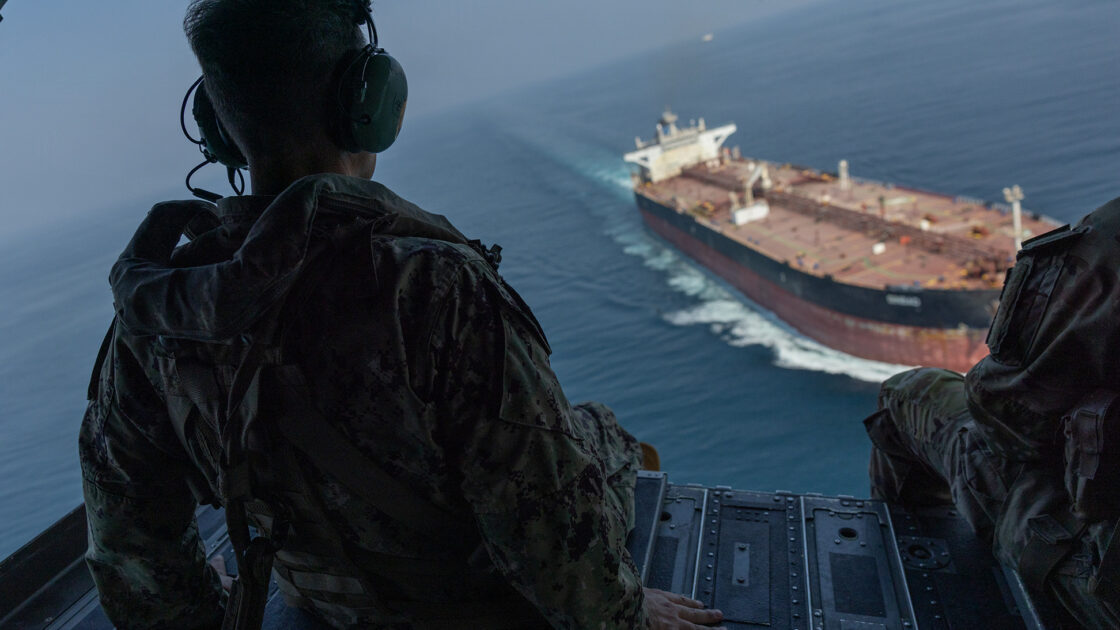
United States President Donald Trump claimed the US has almost sealed Iran off from the rest of the world following a new military supply network crackdown. The announcement came a day after the US Central Command (CENTCOM) introduced Task Force Iron Gate to target land routes and the Caspian Sea.
Task Force Iron Gate Operations
CENTCOM announced that Task Force Iron Gate will aim to prevent Iran from using ground routes to transport advanced weapons and other materials. Trump stated on Truth Social that the task force was in full force and effect, adding that this unit combined with the US naval blockade of the Strait of Hormuz has virtually cut off what enters and exits the country. Analysts told Al Jazeera, however, that a small intelligence-focused unit cannot seal Iran’s borders or stop its extensive procurement networks without regional cooperation.
Michael Mulroy, a former US deputy assistant defence secretary for the Middle East, told Al Jazeera that the unit aims to find out where weapons systems enter, how they can be cut off, and how Iran transports its energy. Based in Tampa, Florida, the unit will coordinate with other government agencies to prevent the movement of advanced weapons, dual-use technologies, sanctioned materials, and illegal revenue streams across land borders and the Caspian Sea, according to CENTCOM.
Matthew Savill, director of military sciences at the Royal United Services Institute, told Al Jazeera that the mission will rely on satellite imagery, drones, intercepted communications, financial intelligence, and intelligence-sharing. Savill added that he would expect some use of force, including strikes or discreet ground operations, to confiscate components.
Andreas Krieg, an associate professor of defence studies at King’s College London, told Al Jazeera that the unit will operate largely as an intelligence fusion cell. Krieg noted that twenty people cannot police thousands of kilometres of frontiers, explaining that the objective is to make Iranian military procurement progressively more expensive, slower, and riskier rather than to stop every shipment.
Regional Obstacles and Political Challenges
Analysts argue that the main obstacle the US mission will face is political rather than technological, as Iran’s neighbours will be largely unwilling to cooperate. Krieg stated that while Iraq offers some leverage, Iranian-aligned networks remain deeply embedded in its institutions, while Azerbaijan might cooperate discreetly. Turkmenistan would be extremely reluctant to jeopardise its neutrality or relationships with Russia and China, and Pakistan is unlikely to participate openly while mediating between Washington and Tehran, he added.
Rami Khouri, a public policy fellow at the American University of Beirut and a non-resident senior fellow at the Arab Center Washington DC, previously told Al Jazeera that Iran’s history as a trading nation makes the US mission near impossible. Khouri noted that an enormous web of contacts built over thousands of years with traders, partners, and allies across the region, especially in Asia, makes it virtually impossible to seal off every route.
Krieg also expressed concern about mission creep, warning that intelligence gathering can quickly become pressure for seizures, border closures, or military strikes against logistical infrastructure. Joe Kent, a former top US counterterrorism official, argued on X that CENTCOM is using the task force to subvert ongoing diplomatic efforts by the vice president. Meanwhile, Mahjoob Zweiri, a professor of contemporary history and politics at Qatar University, told Al Jazeera that the initiative may remain merely symbolic due to the lack of US military presence and access to the Caspian Sea.