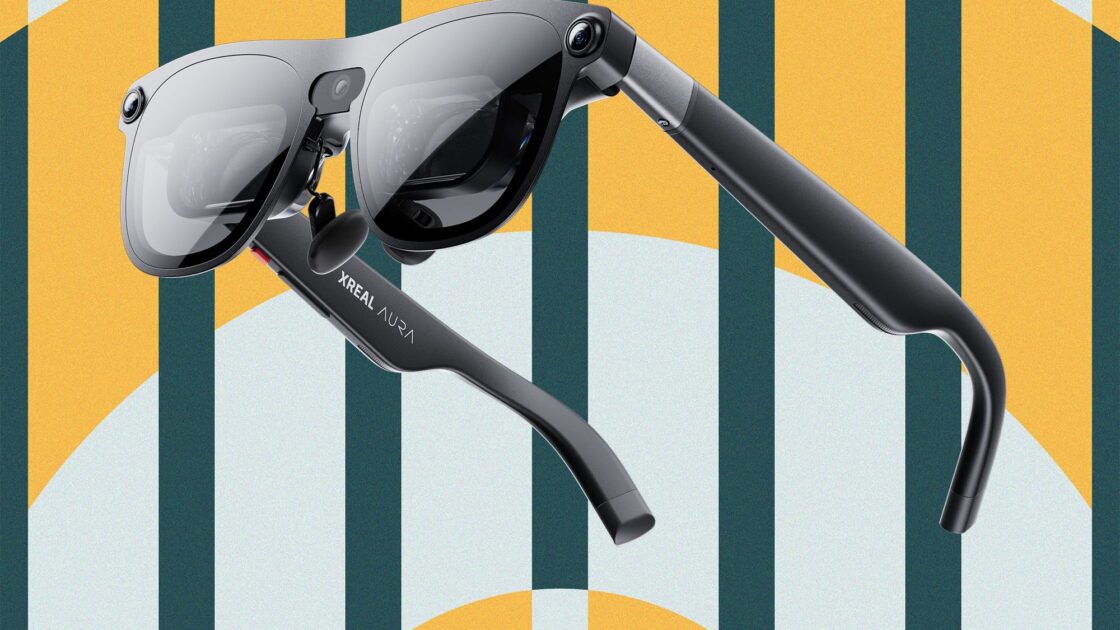
Xreal has launched the Xreal Aura, a $1,279 pair of extended-reality glasses powered by Google’s Android XR platform. These glasses are designed to project virtual screens into the user’s field of vision while incorporating augmented-reality features for real-world interaction.
Design and Hardware
The Aura glasses enter the market ahead of upcoming Android XR hardware from Google and Samsung, which are being developed in collaboration with brands like Warby Parker and Gentle Monster. While those future devices are expected to compete with Meta’s smart-glasses lineup, the Aura functions more like a traditional virtual reality headset condensed into a glasses-like form factor. It is positioned as a direct competitor to Meta’s own VR glasses, which are anticipated for release in early 2027.
A significant limitation of the device is its reliance on a wired connection. A USB-C cable extends from one of the glasses’ arms to a dedicated compute puck. This external unit is roughly the size of a smartphone and weighs slightly over half a pound. The puck is available in 12 GB or 16 GB storage configurations and provides approximately four to five hours of battery life during continuous use.
Display and Performance
When functioning as intended, the Aura offers a high-quality experience. The glasses weigh 95 grams and feature a four-microphone array with Bose EQ tuning for audio, though users also have the option to pair wireless headphones. The display resolution is 1920 x 1200 pixels per eye, which provides a noticeable improvement over previous Xreal models. With a 70-degree field of view, virtual elements appear across a wide portion of the wearer’s vision. Because the display does not cover the entire field of view, the user can still see their surroundings, which helps with spatial awareness but can occasionally detract from total immersion during movie viewing.
The primary advantage of the Aura is its ability to run virtually any existing Android application. Xreal anticipates that users will primarily utilize the device for entertainment, such as streaming movies, television shows, or YouTube content. The virtual display can be set to remain fixed in space or follow the user’s head movements. Additionally, the glasses can be disconnected from the compute puck to serve as an external display for other devices, such as a Steam Deck. However, performance issues were noted when attempting to play graphics-intensive titles like Cyberpunk 2077.