Table of Contents
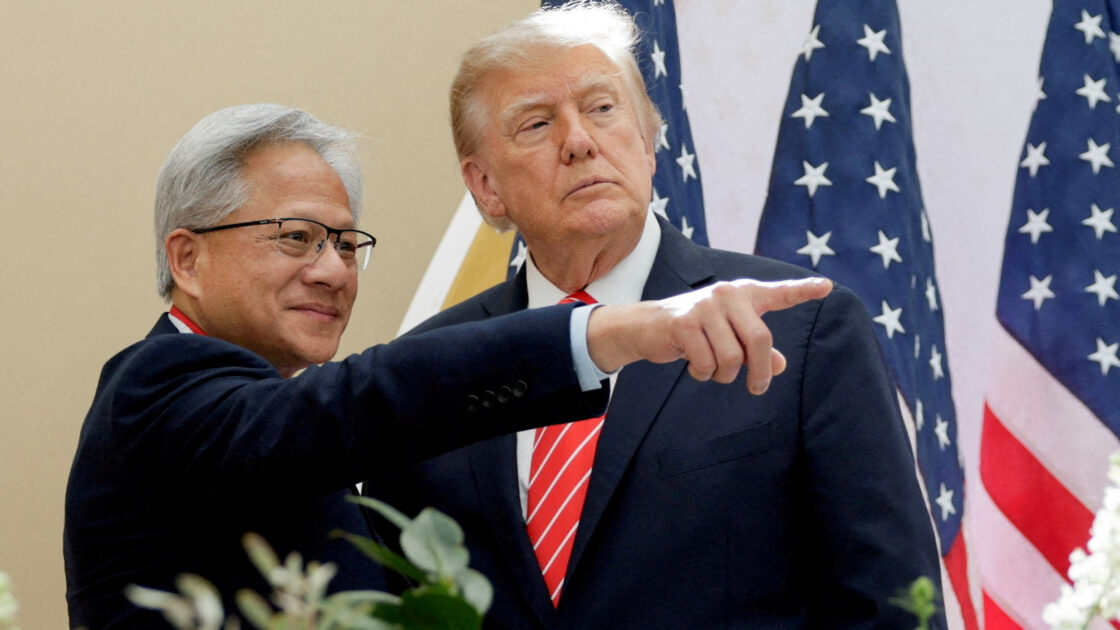
United States President Donald Trump travels to the Chinese city of Shenzhen next week for the Asia-Pacific Economic Cooperation summit, where he is scheduled to meet Chinese President Xi Jinping. The trip unfolds as Jensen Huang, Nvidia’s outgoing chief executive and a prominent Silicon Valley ally of Trump, faces heightened scrutiny regarding his relationship with Alice Huang, a former Megaspeed executive suspected by US officials of working for Chinese intelligence, an allegation that China has denied.
The Chip Thaw and Huang’s Role
As founder and chief executive of Nvidia, Huang previously urged Washington to relax rules on selling advanced chips to China, contending that broader US technology adoption would preserve American leadership in artificial intelligence. In December 2025, Trump approved sales of the H200 chip to China, mandating that 25 percent of proceeds go to the US government, despite resistance from congressional China hawks from both parties. Huang later joined Trump’s delegation to Beijing in May to help unlock delayed shipments, though deliveries remained low due to slow import approvals from Beijing aimed at supporting local chipmakers.
Trump has maintained support for Huang throughout the personal scandal, describing him as an honorable individual. However, Nvidia announced on Thursday that Huang would step down as chief executive, casting doubt on his participation in future delegations.
Impact on US-China Relations
Analysts suggest that Huang’s departure and the surrounding scandal are unlikely to immediately shift ties between Washington and Beijing. Steve Okun, a Singapore-based geopolitical analyst, told Al Jazeera that bilateral relations remain at best a stalemate. Instead, Okun noted that ongoing US restrictions on AI product sales and the informal diffusion of these technologies are far more likely to generate future tensions between the two nations.
Gabriel Wildau, managing director at Teneo, told Al Jazeera that Trump shows no intention of disrupting the current US-China rapprochement, though he cautioned that the president might encounter renewed pressure from Congress and administration hardliners. Meanwhile, Carsten Holz, an expert on the Chinese economy at the Hong Kong University of Science and Technology, told Al Jazeera that Trump lacks a coherent China policy, making his stance in the Shenzhen talks difficult to predict, while adding that Huang’s personal affairs will hold little relevance for overall state relations.
Congressional Pressure and Chinese Response
Pressure for a harder line on China stems largely from Congress, where Democrats will take control of both houses in January. Lian Jye Su, chief analyst at Omdia, stated that maintaining a tough stance on AI and China is a rare bipartisan consensus, adding that Trump will protect his political legacy on the matter. On Wednesday, Democratic Senators Elizabeth Warren and Chris Coons urged Commerce Secretary Howard Lutnick, Secretary of State Marco Rubio, and White House Chief of Staff Stephen Miller to preserve all records concerning Nvidia chip exports to China, expressing deep national security concerns.
In response, Beijing rejected the espionage allegations and accused Washington of fabricating them to justify a technological blockade. Ministry of Foreign Affairs spokesperson Mao Ning stated on Thursday that the US must stop using spy narratives as a pretext for restrictions, while affirming China’s willingness to work with the US to implement prior agreements between the two leaders. Following the news, shares in leading Chinese graphics processor makers including Moore Threads, MetaX, and Cambricon rose nearly 10 percent.
Okun expects political pressure to escalate next year, pointing to potential measures such as the passage of the Remote Access Security Act by Congress to curb cloud-based chip access, or new Department of Commerce export controls targeting Megaspeed and shipments to countries like Singapore and Malaysia. Such actions could strain bilateral ties in 2027, even if they do not materialize during next week’s summit.