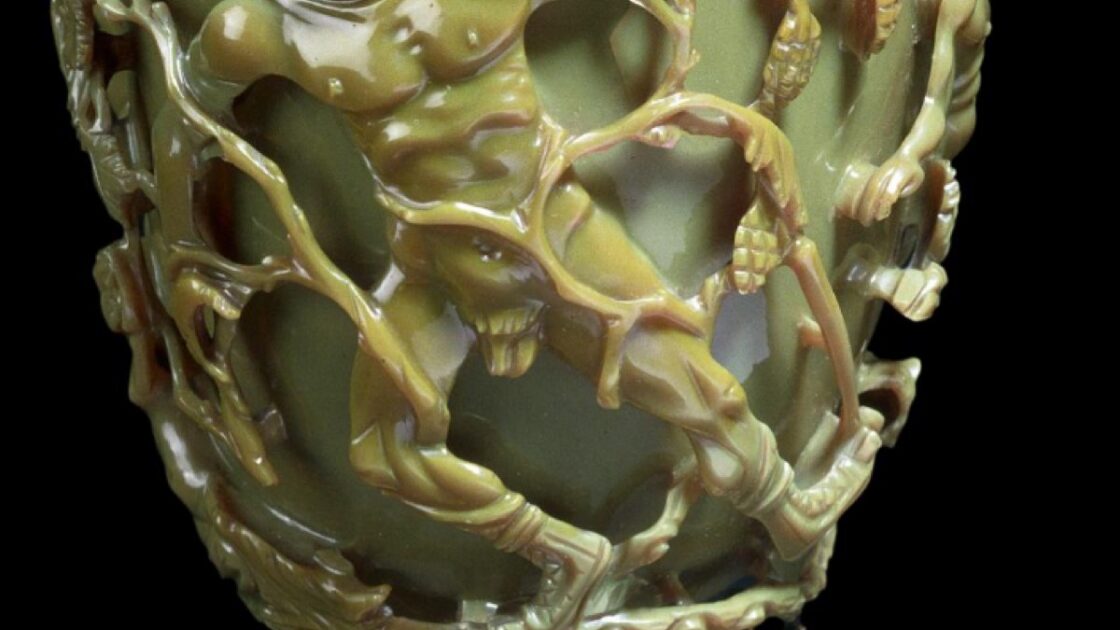
Dating back to approximately 400 CE and crafted from dichroic glass, the Lycurgus Cup is renowned for displaying different colors depending on the lighting conditions. Named after the depiction of King Lycurgus of Thrace on its surface, the cup appears green when illuminated from the front and shifts to a deep red when lit from behind. Researchers at the University of Sheffield have now successfully replicated the original recipe to produce a modern glass sculpture featuring this exact optical phenomenon.
The Mystery of Ancient Nanoparticles
Regarded as one of the seven glass wonders of the world, the artifact is one of only 40 surviving glass cage cups. The reason behind the unusual color transformations remained unexplained until 2007, when researchers determined that the shifts were caused by nanoparticles embedded within the material. These particles resulted from Roman artisans blending finely pulverized gold and silver into the mixture. The nanoparticles alter how electrons inside the cup vibrate when exposed to light, causing the perceived color to change based on the viewer’s perspective.
This mechanism mirrors the process behind the shifting colors of 19th-century daguerreotypes, which occur due to nanoparticle scattering properties. During production, the Romans incorporated salt while melting silicon sand to create the glass, and these salts included gold atoms. During melting, these atoms aggregate to form nanoparticles that generate the colors, a technique fundamental to all stained glass. This process also parallels how the precise lattice-like structures of photonic crystals create natural iridescent colors, such as those found on butterfly wings or in opals.
Comparing Ancient and Photographic Artifacts
A significant distinction exists between the two techniques: the nanoparticles in the cup are embedded directly within the glass, whereas in a daguerreotype, they rest atop a substrate. This surface placement introduces reflection that does not occur with an artifact like the Lycurgus Cup, meaning particle scattering depends heavily on the underlying substrate. Furthermore, coating a daguerreotype’s surface with a layer of gold shifts the colors further toward the red spectrum.
This color shift aligns with a 19th-century photographic technique known as gilding. In this process, photographers applied a solution of gold salt to the image to attain warmer tones and sharper contrast.