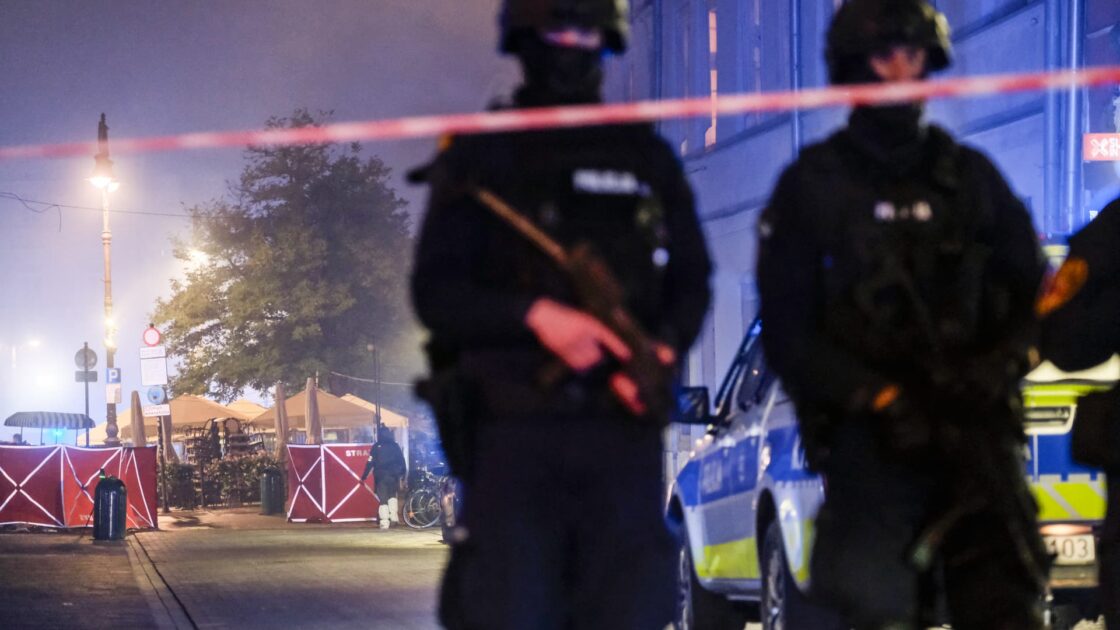
Poland began two days of national mourning on Sunday and police bolstered security following a mass shooting in the southern city of Krakow. The government stated that the attack, which left six people dead, was likely inspired by far-right ideology.
Investigation and Suspect Background
Saturday’s attack took place in the historic main square of Krakow, a UNESCO World Heritage Site that draws global visitors. Sixteen people sustained injuries in the incident, which included two police officers and the suspected gunman. The suspect, a 24-year-old Polish man, remained in critical condition in a hospital, according to local authorities. Foreign nationals were among the casualties, with one fatality identified as a British citizen and another as Austrian. Five other foreign nationals from Austria, Germany, Portugal, Russia, and Britain suffered wounds.
In Ostrowiec Swietokrzyski, the suspect’s hometown located about 200 kilometers north of Krakow, police discovered the bodies of his parents and sister at his residence. Daniel Prokopowicz, spokesperson for the Prosecutor’s Office, stated that it was highly likely the same person carried out the killings in both locations, though investigations remained ongoing. The three victims found at the home bore gunshot wounds. Authorities recovered seven firearms and a significant quantity of ammunition from the property, according to Prokopowicz.
Certain nationalist politicians questioned statements made on Saturday by Interior Minister Marcin Kierwinski regarding the far-right ideological motivation behind the attack. Przemyslaw Czarnek, deputy head of the conservative opposition PiS party, wrote on X that the interior minister should face political consequences if he misinformed the public, demanding immediate explanations and access to the basis for those statements. The suspect was a member of a shooting club, though authorities released little additional information about him.
Mourning and Security Measures
The main market square in Krakow’s old town and surrounding streets stayed closed, with police permitting only essential workers to pass. City hall flags flew at half-mast while numerous nearby cafes remained closed, and mourners left candles at various locations in the district. State news agency PAP reported that St Mary’s church suspended its traditional hourly trumpet call for 12 hours to honor the dead, marking the first time this had occurred since 1939.
Police in Warsaw announced on Saturday that security measures were being strengthened in tourist-heavy areas of the capital. Barriers went up on streets leading to Krakowskie Przedmiescie street in the historic center of Warsaw. Local residents and tourists expressed profound shock over the weekend.
Witold Slowikowski, a local resident, described the event as terrible and expressed concern that it could signal a new era for the country, noting that such incidents had never happened previously in Poland. Maria, a 20-year-old cafe employee in Warsaw, stated that she almost burst into tears upon learning of the shooting, adding that recent occurrences were genuinely impacting public feelings of safety. An editorial in the leading daily newspaper Rzeczpospolita noted that the mass shooting brought a brutal end to an era where Poland was viewed as an island of safety.
Government officials and members of the public commended the response of the police officers who confronted the gunman, who carried a semi-automatic rifle. A regional government official announced at a press conference that the two officers, who suffered gunshot wounds during a close-range shootout while subduing the attacker, had regained consciousness after undergoing surgery. Prime Minister Donald Tusk praised their bravery in a post on X, stating that they disregarded personal risk and likely saved many lives.