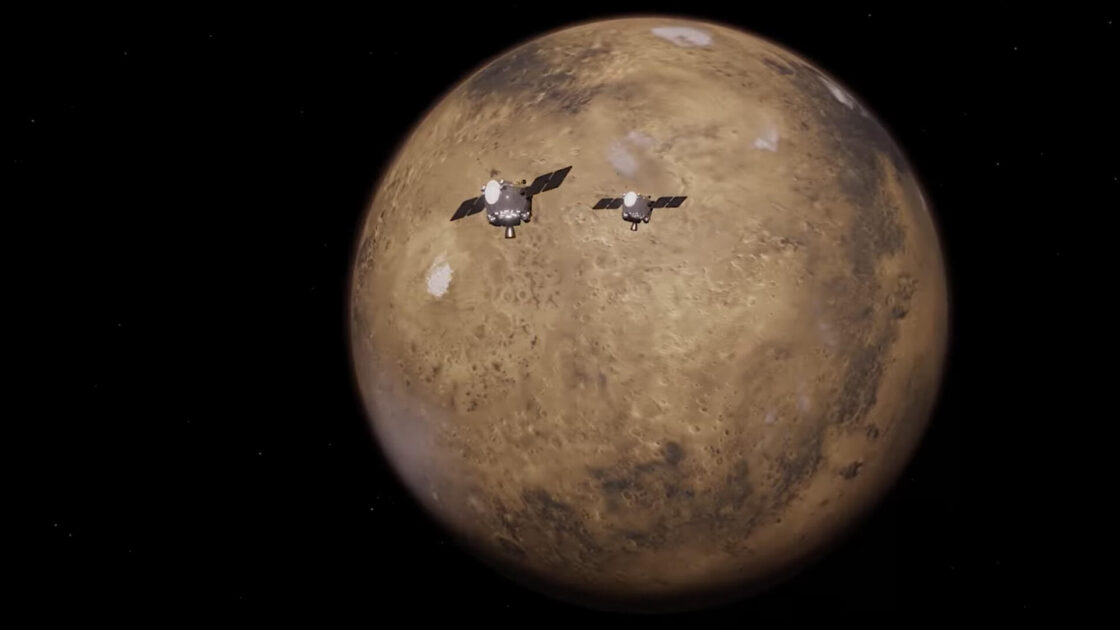
NASA’s Escapade mission is officially en route to Mars after its twin spacecraft, nicknamed Blue and Gold, completed a powered gravity-assist flyby of Earth. Launched just over a year ago, the probes spent a year looping near Earth before executing the maneuver this month.
A First-of-Its-Kind Maneuver
Named after the school colors of UC Berkeley where they were built, Blue and Gold completed NASA’s first powered Earth flyby. While spacecraft traditionally use planetary or solar gravity to slingshot forward—such as Voyager 1—Escapade combined Earth’s gravity with onboard thrusters to generate extra speed. Because there are two probes, NASA personnel performed the maneuver twice.
The primary scientific goal for the twin satellites upon arrival is to measure Mars’ magnetosphere. Researchers believe the solar wind stripped the magnetosphere away eons ago when the planet likely possessed liquid water.
The 10-Month Journey Ahead
The twin probes are now spending the next 10 months traveling through outer space. Their trajectory is timed to intersect Mars’ orbital path so that the red planet captures them in its orbit upon arrival. NASA states that both spacecraft are scheduled to reach Mars by early September next year, bringing their total time in space to 22 months.
Mars missions require extensive deep space travel, precise timing, and substantial fuel unless launched during specific windows. This standard method is known as the Hohmann Transfer. NASA deliberately launched Escapade a year early so the satellites could wait in a gravitational sweet spot known as the L2 Earth-Sun Lagrange point, located on the opposite side of Earth from the sun, until the Mars launch window opened.
Validating a New Strategy
Once the window opened, the satellites fired their thrusters, executed the Earth gravity-assist flyby, and propelled themselves into deep space. According to Jeff Parker, CTO of Advanced Space and lead mission designer, this approach allows agencies to launch payloads into orbit at any time and use Earth gravity assists for a boost, bypassing the traditional requirement to wait every two years for direct planetary alignment.
Japan’s national space agency, JAXA, launched its MMX spacecraft on October 20 using the traditional direct Hohmann Transfer method to reach Mars’ moons, Phobos and Deimos. Despite launching roughly two weeks after Escapade’s gravity-assist slingshot on November 9, JAXA’s MMX is slated to arrive in August next year, just weeks ahead of Escapade. This timeline demonstrates that both methods achieve travel destinations in approximately the same duration, validating NASA’s new trajectory strategy.