Table of Contents
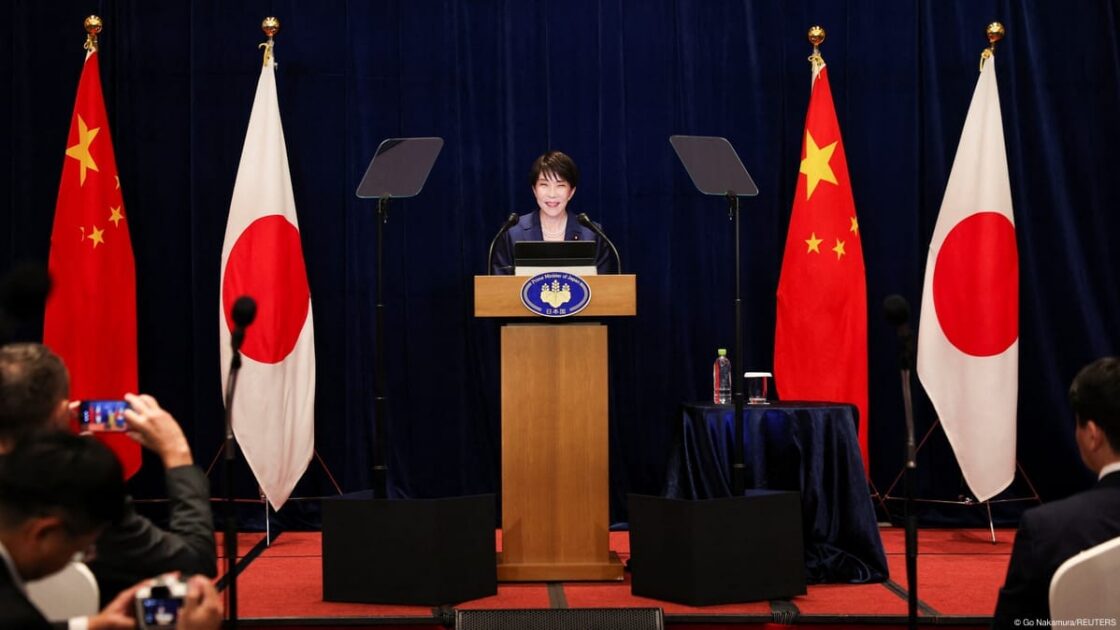
Japanese Prime Minister Sanae Takaichi received a cold reception from China during the recent Asia-Pacific Economic Cooperation (APEC) summit in Shenzhen. The diplomatic chill followed mounting tensions over Taiwan and regional security, leaving bilateral ties deeply strained.
Frosty Welcome and Closed Doors
Upon arriving in Shenzhen on November 18 for the two-day summit, Takaichi encountered an immediate logistical hurdle when the mobile stairs to her aircraft fell short of the threshold, forcing her to grip the door frame and step down around 40 centimeters to the top step. As reported by Deutsche Welle: DW.com – Top Stories (dw.com), she received a low-key welcome on the tarmac devoid of the musical performances, cheering crowds, or traditional dances afforded to many other regional leaders.
Japan’s Yomiuri newspaper reported that Chinese leader Xi Jinping gave a cold reaction when Takaichi met him at the dinner reception. Unlike other leaders who managed brief one-on-one meetings with Xi on the sidelines, the Japanese delegation was denied such access.
William Yang, a Taiwan-based analyst for the International Crisis Group, told Deutsche Welle: DW.com – Top Stories (dw.com) that the level of frostiness was glaringly obvious from the moment the plane landed, calling the aircraft step issue a deliberate contrast to how others were greeted. Yang noted that the ice failed to break when Takaichi attempted to speak with Xi during the dinner.
Historical Baggage and Rising Tensions
Bilateral relations are burdened by a troubled history involving the Japanese invasion of China in the 1930s and subsequent occupation. David Adebahr, a professor of international relations and Asia-Pacific security policy at Kobe University, told Deutsche Welle: DW.com – Top Stories (dw.com) that Tokyo’s post-normalization policy of engagement stalled in the mid-2000s due to China’s rising military spending, the breakdown of East China Sea talks in 2006, and a resurgence of nationalism.
Frictions escalated sharply in November 2025 when Takaichi stated in Japan’s parliament that any contingency involving Taiwan would inevitably threaten Japanese national security. Although Adebahr described her remark as merely voicing the internal logic of Japanese security planning, Beijing reacted with fury, demanding a retraction.
China subsequently restricted exports of critical rare earth minerals to Japan, banned Japanese seafood imports, and discouraged tourism to Japan. Adebahr noted that Beijing believes it holds superior leverage due to Japanese resource dependence, a visible military presence near Japan alongside Russia, and a U.S. administration urging Tokyo to de-escalate rather than offering firm backing.
Navigating a Political Tightrope
Takaichi faces a difficult political dilemma as a conservative leader who has criticized Beijing’s military buildup and pressure on Taiwan, leaving her unable to yield to Xi’s demands without alienating her hardline base. Yang described the situation as a major test of leadership, forcing her to walk a political tightrope between easing tensions and preparing the nation for potential contingencies.
Yang predicted that China will likely maintain its pressure by limiting targeted exports and asserting alongside Russia and North Korea that Japan is remilitarizing. He added that Tokyo may seek opportunities to signal goodwill for small-scale compromises, though a complete dynamic reset depends on the foreign policy trajectory of the Trump administration.
Despite the frosty diplomatic climate, Adebahr believes a full decoupling is unlikely because complex economic interdependencies mean trade, technology, and critical minerals are now treated as security issues. He concluded that transaction costs would remain far too high for either side to completely sever ties.