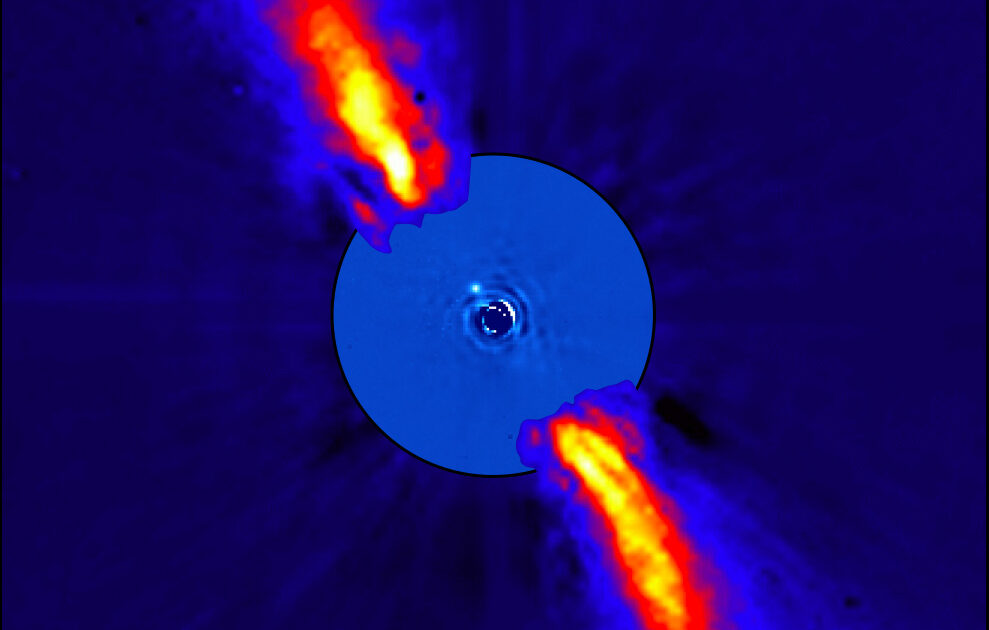
Astronomers using the James Webb Space Telescope have detected water and carbon dioxide ice within the debris disk surrounding Beta Pictoris, a young star located roughly 64 light-years from Earth. Led by astronomer Sarah Betti at the Space Telescope Science Institute in Baltimore, researchers detailed their findings in a new Science study.
Investigating Beta Pictoris
At approximately 20 million years old, Beta Pictoris is surrounded by a vast disk of dust and rubble where planet formation is ongoing, and astronomers have already identified three planets in the system. The star has been heavily studied since its disk became one of the first ever imaged in 1984. Because the system is viewed almost edge-on, it serves as a natural laboratory for observing the growth of planetary systems.
The system functions as a debris disk where constant collisions among comets and planetesimals replenish the dust. In the outer regions of the disk, temperatures are low enough for water and other volatile molecules to freeze into solid ice. Researchers noted that the disk maintains a large reservoir of carbon monoxide gas, which ultraviolet stellar light should normally destroy within 50 to 300 years. The continued presence of this gas implies it is steadily released from ice during collisions between volatile-rich comets.
Uncovering the Hidden Ice
The physical properties of the planet Beta Pictoris b previously indicated that it formed from ice-rich material. Despite strong indicators that the system contained abundant ice, earlier searches had been unsuccessful. Past attempts to detect water vapor came up empty, and a targeted search for the specific wavelength signature of water ice in starlight at 3 micrometers also failed.
The recent observations with the James Webb Space Telescope revealed that the water ice is glassy rather than crystalline. Furthermore, this ice is mixed with carbon dioxide in proportions similar to those observed in comets within our own Solar System. According to the research team, these results indicate that the essential ingredients needed to form water-rich worlds may be widespread around young stars.