Table of Contents
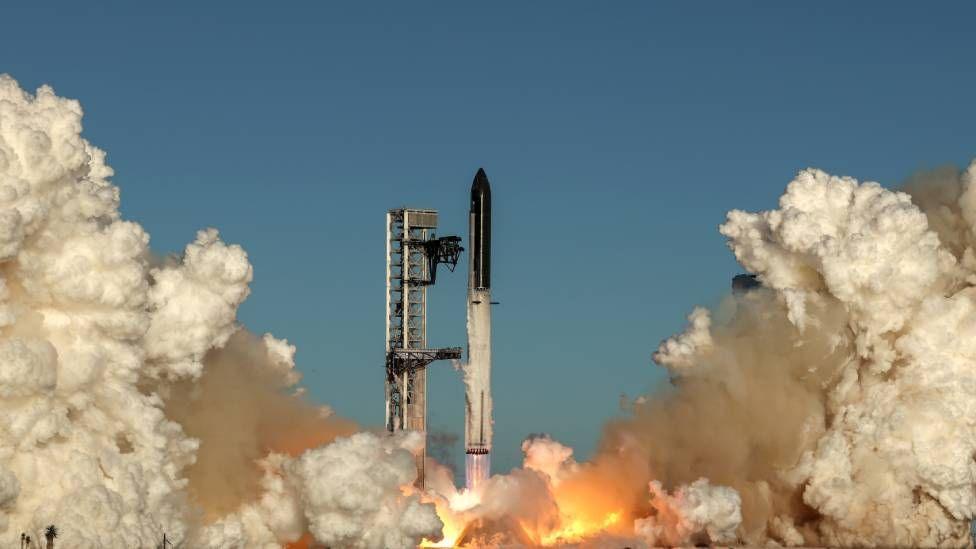
SpaceX will decide later whether to try to catch the upper section of its massive Starship rocket using mechanical arms on its launch tower as the vehicle returns to Earth. The company originally aimed to recover both the lower and upper stages during its 15th test flight, but the initial attempt to catch the booster had to be aborted.
Launch and Booster Abort
The 124m-tall (407ft) rocket launched successfully from the Starbase facility in Boca Chica, Texas, at 16:47 local time on Friday. Mission control initially gave a “go” for the launch tower to grab the bottom part, known as the Super Heavy booster, six and a half minutes into the flight. However, the booster initiated an automated abort and diverted to the ocean, hovering above the water before bursting into flames and exploding.
A SpaceX spokesperson stated during a livestream of the launch that safety remains the top priority while testing unproven maneuvers on these vehicles, noting the company prioritizes ensuring each maneuver is performed safely. The upper part of the rocket continued its journey into space, successfully deploying 26 satellites for the Starlink high-speed internet constellation.
The Upper Stage and Reusability Goals
The upper section, designated as the Ship, is scheduled to complete 14 orbits around the Earth before returning to the launch tower about 22.5 hours after takeoff, at approximately 15:15 local time on Saturday. While SpaceX has previously caught the Super Heavy booster on three earlier test flights, the upper stage—which first reached orbit in September—has never been grabbed by the launch tower arms, known as chopsticks.
Before the flight, SpaceX noted it would only attempt to catch the Ship after carefully evaluating the vehicle in space, with multiple predefined points available to bring the rocket stage down safely into the ocean if any issues arise. Developing a fully reusable rocket is a long-standing goal for SpaceX to fly repeatedly and lower costs, following its 2015 achievement as the first company to vertically land a Falcon 9 booster.
Prof Malcolm Macdonald, president of the Royal Aeronautical Society, explained that landing an entire Starship rocket could transform space access economics. He noted that a successful flight would not prove the entire model by itself, but could mark a major transition from proving Starship can fly to demonstrating how it can operate.
Implications for Nasa and Lunar Missions
With SpaceX operating as a public company following its market debut earlier this year, shareholders and Nasa are closely monitoring the flight’s progress. Starship’s development has direct consequences for Nasa’s goal to land humans on the Moon, a timeline that includes configuring the Ship into a lunar lander under a Nasa contract to transport astronauts to the surface.
Nasa’s Artemis III mission, slated for summer 2027, will involve four astronauts aboard the Orion spacecraft docking with landers from both SpaceX and rival company Blue Origin, which holds a separate contract using its New Glenn rocket. Both companies face demanding schedules, with Starship development moving slower than intended and Blue Origin experiencing a major setback when a rocket explosion destroyed its Florida launchpad earlier this year, pushing its return to flight into early 2027.
Nasa faces mounting pressure to hit its deadlines amid a lunar race with China, which aims to land taikonauts on the Moon by 2030, according to remarks from Nasa administrator Jared Isaacman regarding the competition between the US and China.
The Ship is scheduled to complete its return journey and potential tower catch attempt on Saturday afternoon.