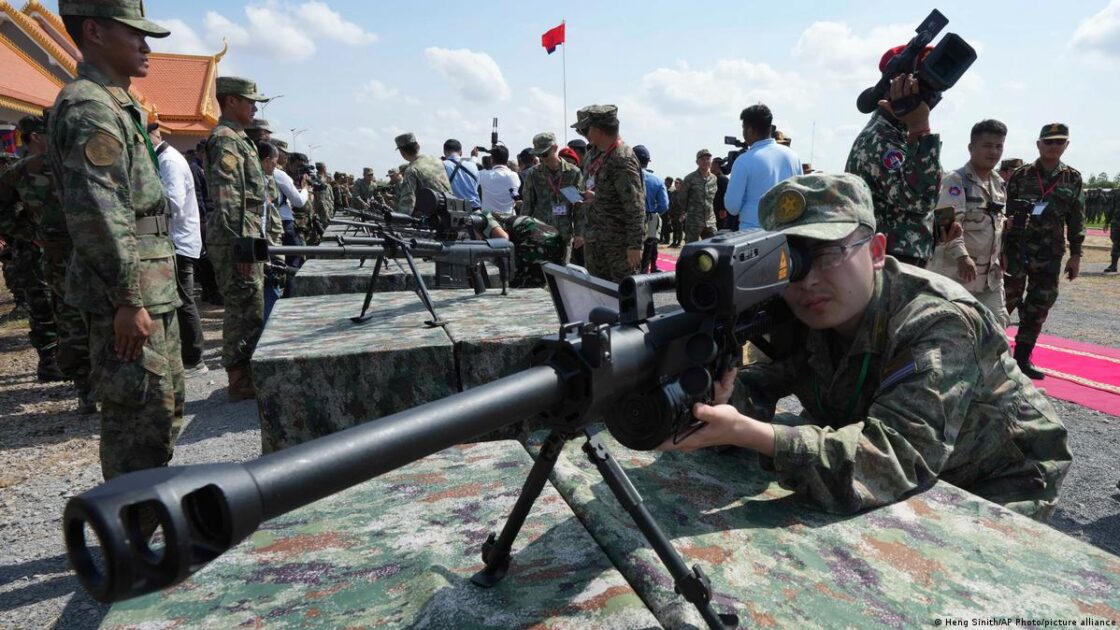
China is increasingly expanding its military cooperation in Southeast Asia alongside its growing economic influence in the region. Recent developments involving new facilities in Laos and Cambodia have raised questions about Beijing’s broader strategic footprint and access.
New Facilities and Growing Security Ties
China’s Foreign Minister Wang Yi invited counterparts from Laos, Cambodia, Vietnam, Thailand, and Myanmar to Beijing in early November, where the six nations agreed on closer economic and security cooperation. This visit highlights a broader trend of expanding military ties beyond traditional trade and infrastructure partnerships.
At the end of September, China and Laos opened a joint military support and training center north of the Laotian capital, Vientiane, at the Ban Keun airfield intended initially for training Laotian air force pilots. Earlier in 2025, China also expanded its footprint at Cambodia’s Ream naval base on the Gulf of Thailand, utilizing the facility for logistics and training. While Japanese and Vietnamese ships can visit the port, they dock at a southern quay, and it remains unclear if other navies share identical access conditions with China.
Marco Bünte, a professor of Asian politics at the University Erlangen Nuremberg in Germany, stated to Deutsche Welle: “It remains to be seen how this will change China’s military access to Southeast Asia.” Bünte noted that Laos and Cambodia have been close military partners of Beijing for some time, and the new facility represents another step in deepening cooperation. If this pattern continues, Bünte explained, “China would gain strategic depth in mainland Southeast Asia” and secure better military access to the South China Sea.
Johann Fuhrmann, head of the Konrad Adenauer Foundation’s Beijing office, told Deutsche Welle that observers should distinguish between training local pilots and potential future use by Chinese armed forces. “China gains influence when it co-designs the training and operation of such facilities over several years,” Fuhrmann said.
Assessing Capabilities and Regional Reactions
While Bünte emphasized that China is expanding its operational capabilities in the region, he added that Beijing has not yet achieved military hegemony. Questions surround the Laotian airbase since Laos operates only three light combat aircraft by Russia’s Yakovlev works alongside military transporters and helicopters. According to the aviation media outlet FlightGlobal, four Chinese K-8 two-seat intermediate jet trainers and light attack aircraft are in service there, while satellite images analyzed by the Reuters news agency in early October showed eight K-8s at the base without confirming permanent stationing.
Fuhrmann cautioned against jumping to conclusions, noting that the concept of a Chinese air corridor remains a future scenario rather than a proven reality. He pointed out that the 2,000-meter (6,562-foot) runway at Ban Keun is too short for large Chinese bombers, which typically require 3,000 meters. The crucial question, according to Fuhrmann, is whether China will need government approval for every new use or if longer-term commitments exist for crisis situations.
Neighboring countries are reacting differently to Beijing’s growing influence. While Laos, Cambodia, and Myanmar are viewed as closer to China, other Southeast Asian nations are hedging their bets, maintaining economic and diplomatic links with the United States and Western nations alongside China. Vietnam and the Philippines are watching developments particularly closely due to their territorial disputes with China in the South China Sea, and Vietnam maintains close historical ties to Laos.
In early November, the Vietnamese government declared that military cooperation must serve peace and stability, citing the ASEAN Treaty. Although China is not an ASEAN member, it has stated that its activities are not directed against any third parties. Bünte noted that these remain individual steps and time will tell whether they lead to a broader military alliance. Fuhrmann concluded that Western nations must offer tangible contributions to support smaller countries in the region rather than relying on warnings and lectures.