Table of Contents
The Crimean Bridge, a 12-mile-long structure spanning the Kerch Strait, has suffered a major collapse following a coordinated seven-stage Ukrainian military operation. Once a symbol of Russian control over the peninsula, a significant section of the bridge now lies on the seabed after being targeted by long-range weaponry.
A Multi-Stage Operation
According to statements from Kyiv, the operation was designed to systematically dismantle Russia’s defensive layers. President Volodymyr Zelensky explained that for several weeks, the Security Service of Ukraine and the General Staff targeted and destroyed radar systems, air defenses, and electronic warfare assets to clear a path for the final strike.
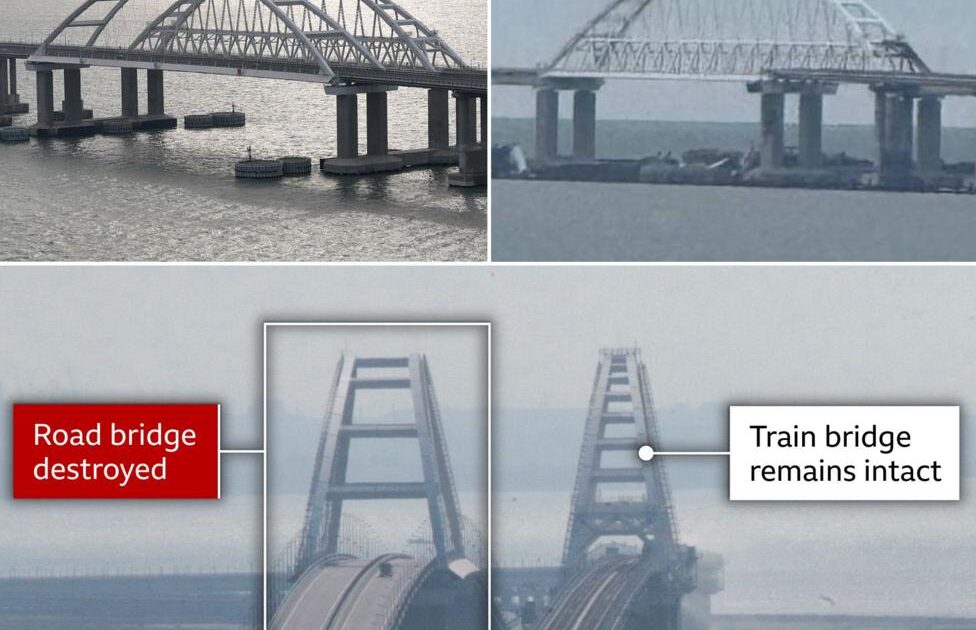
An initial significant attack occurred on 16 November, when drones struck the bridge at night. While this caused visible damage to the road arch, the structure remained standing and traffic was briefly reinstated. However, this proved to be the penultimate phase of the mission. In the early hours of 17 November, the final strikes were launched.
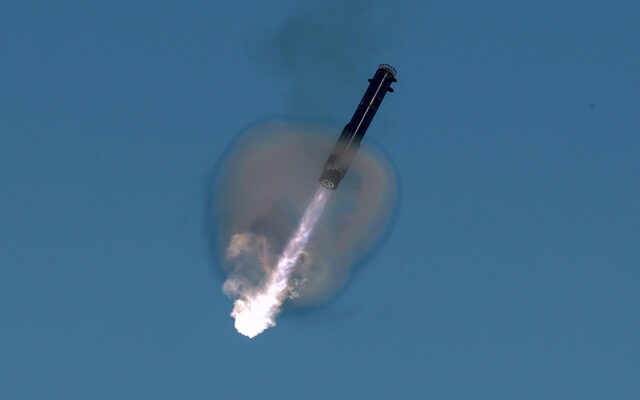
Verified footage from a Ukrainian-made Flamingo missile shows the weapon approaching the bridge’s steel arches before the feed cuts out at impact. Justin Bronk, a munitions expert at the Royal United Services Institute, noted that the Flamingo was likely modified for remote control to increase accuracy. He added that the missile’s heavy warhead made it particularly effective against the bridge’s reinforced concrete supports.
Structural Impact and Future Outlook
The attack resulted in the collapse of a massive road arch, measuring approximately 227 meters in length and weighing thousands of tonnes, into the strait. Daylight images confirm that a 200-meter section of the tarmac was dragged into the sea. While the parallel railway arch remains standing, experts warn that the damage to the main span is catastrophic.
Colin Capriani, a structural engineer at Monash University, told BBC Verify that it is difficult to see how the bridge could be repaired given its vulnerability to ongoing Ukrainian strikes. David MacKenzie of the engineering firm COWI noted that while debris removal might be swift, restoring full road traffic could take more than a year. Kremlin spokesman Dmitry Peskov stated that Russia intends to rebuild the bridge, claiming it will be “even better than before.”
Strategic Consequences for Crimea
The bridge has served as a vital logistics hub for Moscow, facilitating the movement of military supplies and troops to support operations in southern Ukraine. While a land corridor through occupied regions of Zaporizhzhia and Kherson remains available, Ukraine has been systematically targeting transport routes in northern Crimea to isolate the peninsula.
Alternative supply methods, such as ferry crossings, remain limited and vulnerable to Ukrainian naval and aerial drones. Furthermore, the debris from the collapsed arch may obstruct the shipping channel, potentially hindering larger vessels from reaching ports in the Sea of Azov, including the occupied cities of Mariupol and Berdyansk.
Beyond the logistical implications, the destruction of the bridge carries deep symbolic weight. The structure was previously touted by Vladimir Putin as a triumph of Russian engineering and a symbol of the unification of Crimea with Russia. As the conflict continues, the bridge’s collapse serves as evidence of Kyiv’s growing capability to strike high-value, protected targets deep within Russian-held territory.