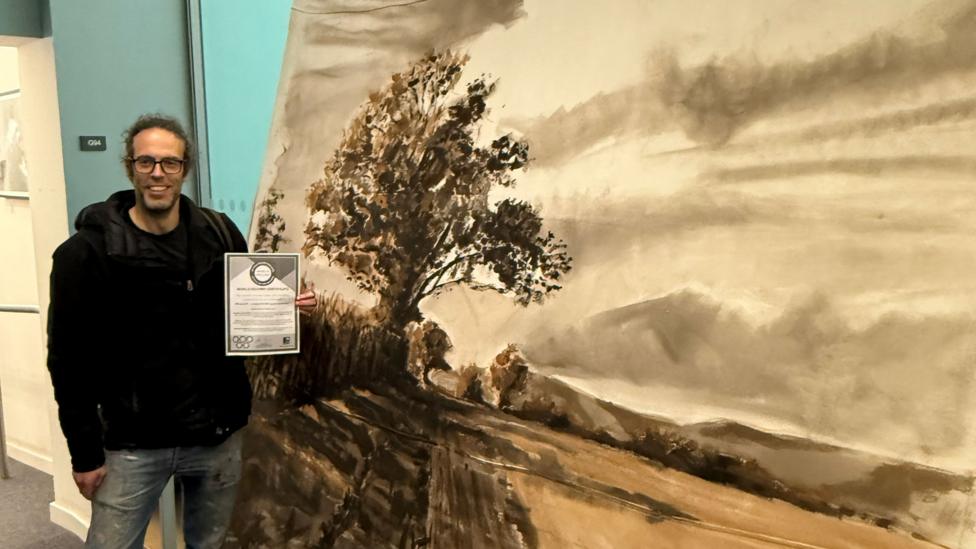
An artist has set a record for the world’s largest soil painting as part of a campaign to raise awareness about the material’s crucial importance. Official Record Breakers in the UK verified that the organisation Save Soil surpassed the previous record of 59,458 square centimeters, creating a new artwork measuring 61,000 square centimeters.
Creating the Record-Breaking Artwork
Phil Lambert, a resident of Cardiff, crafted the piece using four distinct types of soil along with an upcycled wooden frame and canvas provided by Oxford Wood Recycling. The artwork was assembled at University College London and coincides with a newly released report detailing the significance of healthy soils and outlining steps for their restoration.
Lambert stated that he has worked with soil for approximately a decade and finds painting with the medium very familiar. He sourced material from his own garden, his mother’s home, and received donations from the James Hutton Institute in Scotland. He explained that his creation depicts a tree, hedge, and field, noting that his collaborations with scientists educated him on the dangers facing the material.
“If you go back to the fields you were walking in when you were young, you will notice that there is a thinner soil on there and there’s more rock on the surface,” Lambert said.
Pushing for Climate Policy Priorities
The project was designed to draw attention to the movement’s demand that soil regeneration be prioritized at the upcoming 31st UN Climate Change Conference. Save Soil advocates for global improvements in soil health and collaborates with governments to influence policy.
Henry Asplin, a spokesperson for UK Save Soil, described the painting as a visual call to action. He noted that soil serves as the quiet infrastructure of the planet and acts as a major climate solution, yet remains largely absent from national climate plans.
Mark Maslin, a professor and climate scientist at University College London, emphasized that healthy soils regulate water, store carbon, and support food systems and biodiversity. He added that protecting and restoring soil must become central to every nation’s climate strategy to limit warming and secure a liveable future.
Jennifer Robinson of Oxford Wood Recycling expressed support for the cause, noting that environmental care is central to her company’s operations. Coming from a farming background, Robinson stated she has personally observed local soil changes, including large cracks and healthier conditions in areas dense with plants and trees.