Table of Contents
A spacecraft named BepiColombo is approaching its final destination to enter orbit around Mercury, following an eight-year journey covering nearly six billion miles (10 billion km).
Navigating a Hostile Environment
The spacecraft is entering a harsh environment as Mercury sits closest to the Sun, where temperatures swing from a scorching 430C down to -180C amid intense solar radiation. Launching from French Guiana in 2018, the mission is a joint project between the European Space Agency (ESA) and the Japanese Space Agency (JAXA). Because the craft headed deep into the inner Solar System, it faced the immense gravitational pull of the Sun. As a result, it kept its brakes on throughout the entire voyage, taking a complex path that included one loop around Earth, two around Venus, and six around Mercury to decelerate sufficiently for orbit insertion. A propulsion system issue extended the originally planned seven-year trip by an additional year.
The final orbital entry manoeuvre is perilous, requiring a 37-minute handbrake turn to allow the planet’s gravity to capture the spacecraft. Any failure during this step could cause the craft to hurtle past Mercury. Only two previous NASA missions have visited the planet: Mariner-10 flew past three times in the 1970s, and the Messenger spacecraft arrived in 2011 to spend four years in orbit.
Unlocking Planetary Mysteries
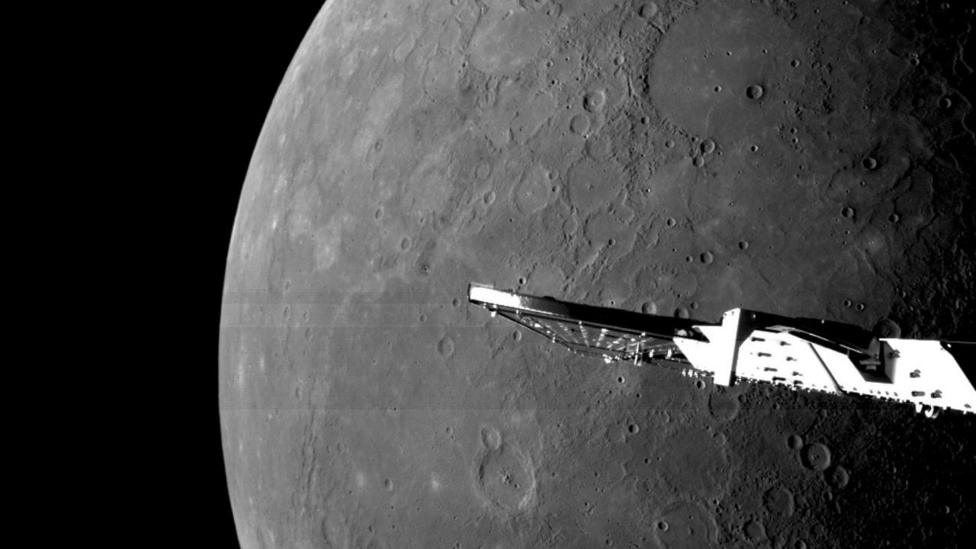
Mercury is slightly larger than the Earth’s Moon and features ancient volcanoes, towering cliffs, and massive craters. Time operates unusually on the planet; a year takes just 88 Earth days because it zips around the Sun quickly, but a single day lasts 59 Earth days due to its slow rotation on its axis. Prof Emma Bunce from Leicester University, a principal investigator on the mission as reported by BBC News, described it as an under-loved planet in the inner Solar System that offers compelling scientific questions regarding its formation, evolution, and interaction with extreme space weather.
Researchers hope the mission will clarify why ice exists in craters within the polar regions and examine thousands of shallow, steep-sided hollows spread across the surface. These hollows are roughly 100,000 years old, and while scientists know they are not impact craters, their precise formation remains unknown. BepiColombo will also investigate why the tiny planet possesses a remarkably large metal core. Prof Bunce explained that the planet might have had its mantle stripped away during an early “hit and run” collision, or through a series of impacts over an extended period, or it could have simply formed that way within a metal-rich region of the early Solar System.
Dual Spacecraft Separation
The mission features two spacecraft stacked together. A few weeks after reaching Mercury, they will separate, with the ESA craft studying the surface up close while the JAXA craft observes from a distance. Jessica Marshall, a systems engineer at Airbus who built the spacecraft, told BBC News that the separation moment would be nerve-wracking for the team after eight years of exposure to harsh space radiation and extreme thermal temperatures. The craft rely on a specially designed spring mechanism that must release gently and twist simultaneously to initiate the spin of the second spacecraft.
With two instrument-packed orbiters surrounding Mercury, the BepiColombo team anticipates finding answers to long-standing questions while likely uncovering new mysteries upon arrival.