Table of Contents
An official sign on the banks of the River Tone at French Weir Park in Taunton warns visitors against swimming, yet local residents continue to enjoy regular dips in the water. BBC News analysis of data from all four UK regulators found that French Weir Park had a failure rate of 68% this summer, making it the worst official bathing site in the UK.
The testing regime and river pollution
French Weir Park has only been designated an official bathing site since 2024, meaning the Environment Agency tests the water between May and September. These tests look for E. coli and intestinal enterococci, faecal bacteria from human or animal guts that can cause illness if swallowed. Swimmers reported suffering from poor health, including diarrhoea, vomiting, and muscle cramps after being in the river.
A BBC investigation into all 700 official UK bathing sites found that more than 10% of coastal sites and 37% of inland sites failed minimum standards over the summer. While poor water quality is often linked to raw sewage spills after heavy rain, bacteria levels remained high during an extremely dry summer, suggesting a constant flow of bacteria entering the rivers.
Tracing the source of bacteria
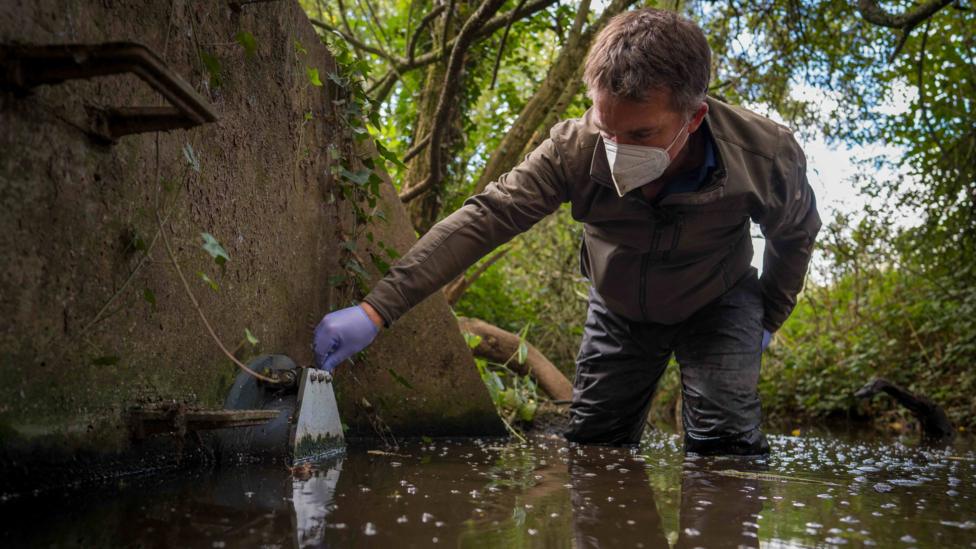
The BBC carried out water sampling near three wastewater treatment works upstream of the Taunton site. Testing showed that treated liquid leaving the Bradford-on-Tone sewage works had about 240,000 colony forming units (CFU) of E. coli per 100ml, which is roughly 250 times higher than safe swimming levels. Dr Rob Morley from Index Microbiology told BBC News that the counts were high for treated effluent, noting that tests above the treatment works showed 199 CFU while samples just below reached 7,701 CFU.
Dr Andrew Thompson from the Institute of Chemical Engineers told BBC News that these bacteria levels were not illegal or unusual because no laws currently regulate how much bacteria water companies may discharge in treated effluent. Environmental DNA analysis conducted with researchers from the University of Bristol indicated that the E. coli in the samples came from a mix of human, animal, and environmental sources, with human origins pointing towards the treatment works.
Jim Flory, a regional manager for the Environment Agency in the south-west, told BBC News that sewage treatment works hold permits to protect ecology and wildlife rather than bathing water regulations designed for swimmers and canoeists. Both the Environment Agency and Wessex Water are investigating the poor water quality in Taunton, though Environment Agency sources told BBC News that constant flows of treated effluent rank high among likely culprits.
Solutions and industry response
Wessex Water stated to BBC News that its treatment works at Bradford-on-Tone operated normally and met all Environment Agency permit conditions. The company added that it has no plans to install ultraviolet disinfection at the site and will publish its conclusions regarding the poor water quality in April 2027.
Ultraviolet lighting systems have been installed at Cassington wastewater treatment works upstream of the River Thames at a cost of £4m to kill bacteria before they reach the river, following poor water ratings at Wolvercote Mill Stream in Oxford. Tessa Fayers from Thames Water told BBC News that such disinfection is expensive and used selectively, with UV systems currently installed at only 160 of nearly 7,000 wastewater treatment works across England.