Table of Contents
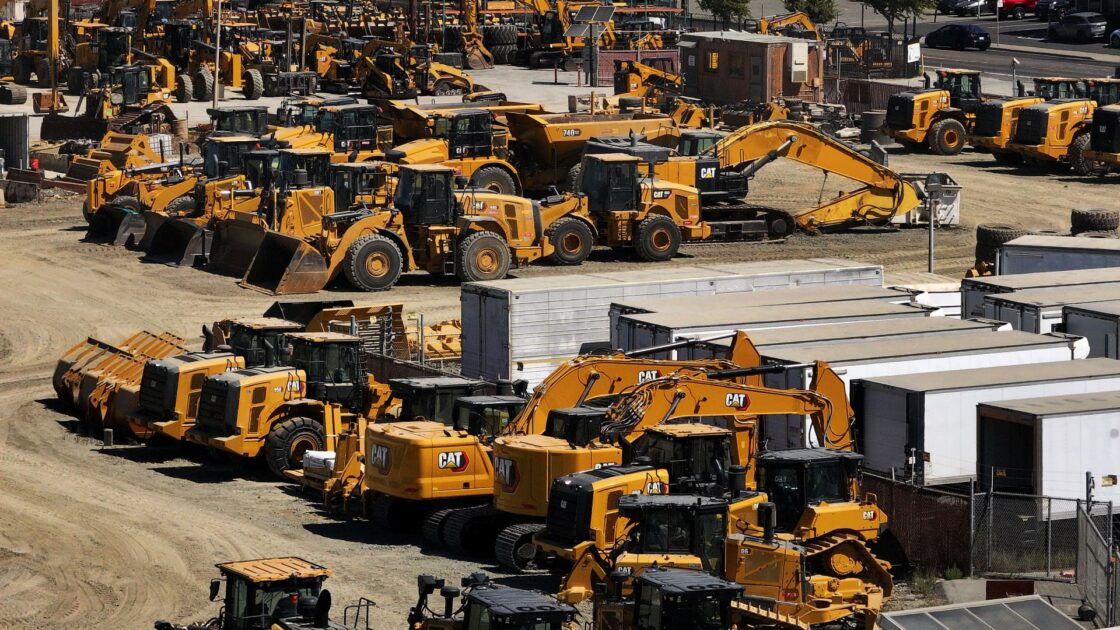
Nondescript lots holding idle bulldozers, trucks, and other heavy machinery are becoming a major focus for Wall Street private investment giants. Major alternative asset managers like Brookfield and Blackstone are increasingly targeting industrial outdoor storage, or IOS, as rising demand for heavy equipment draws institutional capital to the sector.
Wall Street and Institutional Activity
Devin Barnwell, a managing partner and co-leader of Brookfield’s logistics business, stated that the firm has strong conviction in industrial outdoor storage due to its critical role in the supply chain. He explained that while the segment has historically been fragmented, Brookfield sees significant opportunity to bring institutional capital and operating expertise to improve asset efficiency and supply chain resilience. Earlier this year, Brookfield spent $1.2 billion to take Peakstone Realty Trust private in a deal finalized in May, securing a portfolio of over 70 industrial properties primarily consisting of outdoor storage yards.
Blackstone is also expanding its presence in the sector by acting primarily as a lender. Its real estate debt division has issued six loans to outdoor storage owners totaling more than $1.1 billion. This includes a $244 million loan provided in June to Alterra IOS to help finance the acquisition of 37 properties.
Market Growth and High Rents
Data from Newmark Research and property owner Alterra IOS show that rents for industrial outdoor storage approximately doubled across eight major markets between 2020 and the third quarter of this year. Average rent per usable acre climbed by 103.5% to nearly $11,000 monthly, outpacing the 66% increase recorded for traditional indoor warehouse spaces. Rent growth is heavily tied to local infrastructure and energy activity, and property values benefit from proximity to seaports, rail lines, or highways.
Market gains varied by location, with Baltimore leading at a 204% increase, followed by Houston at 159% and Norfolk at 148%, while South Florida and Savannah trailed traditional industrial performance. Lisa DeNight, managing director and head of North American industrial research at Newmark, noted that Savannah’s IOS vacancy remains very tight despite the rent figures, driven partly by past port activity.
Sam Cheema, co-founder of Dallas-based CanTex Capital, noted that supply and demand imbalances are pushing rents and prices higher across the board. Properly zoned infill sites are increasingly difficult to find as many are converted to warehouses or multifamily housing. Because property value is concentrated in the land itself, owners retain the option to redevelop sites as surrounding areas grow.
Opportunities for Smaller Investors
Despite heavy institutional spending, market experts assert that opportunities remain for individual investors and local entrepreneurs. Adam Petrillo, executive managing director at Newmark, affirmed that smaller investors and mom-and-pop operators still control a significant share of well-placed storage in secondary markets, noting that lots as small as three to five acres can deliver robust returns without requiring tens of millions of dollars.
Cheema explained that because IOS properties lack the standardized specifications of traditional warehouses, such as uniform square footage or clear heights, small investors still have a runway to find deals. However, zoning remains a major challenge, requiring investors to carefully research municipal plans to avoid purchasing land in areas where local authorities intend to phase out such use. CanTex Capital actively collaborates with cities and neighborhoods before making purchases to align with community plans.
Alex Sutterer, executive vice president at NAI Hiffman, stated that IOS attracts investors due to lower capital expenditure requirements compared to traditional industrial or multifamily properties, alongside the potential for higher yields. Private investors typically trade IOS at a yield roughly one percentage point higher than traditional industrial properties. Sutterer advised that while institutional competition has raised property values and lease rates, smaller investors can still find viable opportunities in deals below $3 million to $5 million.
Financing and Regional Market Variables
Financing continues to rely heavily on local and regional banks. Kellie McIvor, vice president of acquisitions at Redwood Living, pointed out that interest rates remain high and smaller buyers often face more expensive debt and higher equity requirements because lenders view them as riskier than large institutional investors.
Ross Blankenship, owner of two fenced contractor and fleet yards in Colorado’s Vail Valley under Wins Parking, emphasized that the math must work based on current collections rather than speculative future institutional buyouts. He advised first-time buyers to contact ten local contractors directly to understand prevailing rental rates, noting that while a fully occupied yard yields strong cash flow per dollar of capital expenditure, an empty yard earns nothing.