Table of Contents
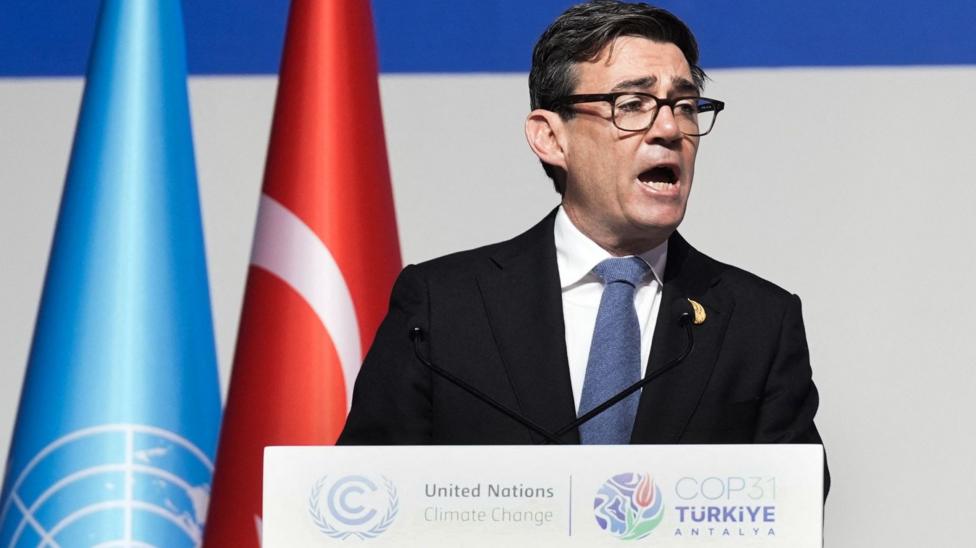
Prime Minister Andy Burnham has warned that the consensus on both science and climate change has “gone”. Addressing world leaders and delegates at the COP31 climate summit in Turkey, he stated that despite this setback, the UK was ready to begin a “new era of British leadership” on the issue.
Climate Security Envoy and Extreme Weather
Opening his speech on Thursday, Burnham discussed the extreme heat experienced in the UK during the past summer, noting it was not normal and marked the hottest on record. According to the Met Office, the conditions were made 130 times more likely because of climate change. The severe weather led to hundreds of school closures, an 11% drop in cereal harvests, and ambulance services facing call volumes exceeding levels seen during the Covid-19 pandemic.
To address the growing threat to homes and public health, the Prime Minister announced the creation of the UK and the world’s first climate security envoy, appointing Dame Madeleine Alessandri to the role. Alessandri, the former head of the Joint Intelligence Committee, stated that climate change and nature loss are increasingly shaping the security environment in which the UK operates, placing additional pressure on resources, economies, and communities worldwide. This appointment is viewed as a strong signal of the UK’s priorities as it prepares to assume the G20 presidency next year.
Professor Lord Nicholas Stern, who warned two decades ago that unchecked climate change could cost the global economy up to 20% of GDP, praised the Prime Minister’s remarks. He stated that the Prime Minister was right to identify climate change as a global security threat and to highlight investments in clean electricity generation as the best protection for households and businesses against volatile fossil fuel markets.
Criticism Over Domestic Policies
Environmental campaigners at the summit argued that the Prime Minister must match his rhetoric with stronger actions. Critics point to recent government policies that have seemingly weakened its green credentials, such as approving the Jackdaw gas field in the North Sea, reducing support for heat pumps, and doubling down on support for Heathrow Airport’s expansion. Beth John, climate adviser at Oxfam, stated that the Prime Minister cannot call for clean power globally while endorsing more fossil fuel extraction domestically. Last month, the government approved the Jackdaw gas field to ensure energy security, while Chancellor John Healey announced funding cuts to the Warm Homes Plan, which provides grants and loans for heat pump installations. Additionally, media speculation this week suggested the government might water down electric car sales targets, though officials insist no final decision has been made.
Regarding emission reductions, Burnham confirmed that his government remains committed to achieving net zero by 2050 while simultaneously lowering energy bills. He emphasized that cutting dependence on fossil fuels and increasing electrification—meeting more energy needs through renewable electricity—are vital to this goal. Turkey, the co-host of COP31, is urging countries to commit to meeting 35% of their energy supply from electricity by 2035, up from about a fifth currently. Successfully transitioning petrol and diesel cars to electric vehicles and moving from gas boilers to electric heat pumps are critical steps toward meeting this electrification target.
Global Context and Rising Sea Levels
Burnham was the notable sole G7 leader to speak at this year’s conference, reflecting waning support for the COP process. Acknowledging this reality in a speech closely mirroring remarks made by Sir Keir Starmer last year, he said the consensus once enjoyed on science and climate has vanished, and the world is now on track to reach 1.5 degrees of warming. King Charles III also sent a message ahead of the address, expressing hope that a spirit of partnership and common purpose would inspire collective action for the planet and future generations.
Other leaders slated to speak on Thursday included representatives from island states such as Tonga, Tuvalu, and the Solomon Islands, where the impacts of climate change are already threatening daily life. With most of their land sitting just meters above sea level, rising waters have forced many residents to abandon their homes. Last year, summit co-host Australia introduced the world’s first climate visa for Tuvalu citizens seeking evacuation, with the initial intake heavily oversubscribed by over a third of the population. On the opening day of the conference, the World Meteorological Organization reported that global mean sea levels have reached their highest point since records began as glaciers continue to melt and oceans expand.