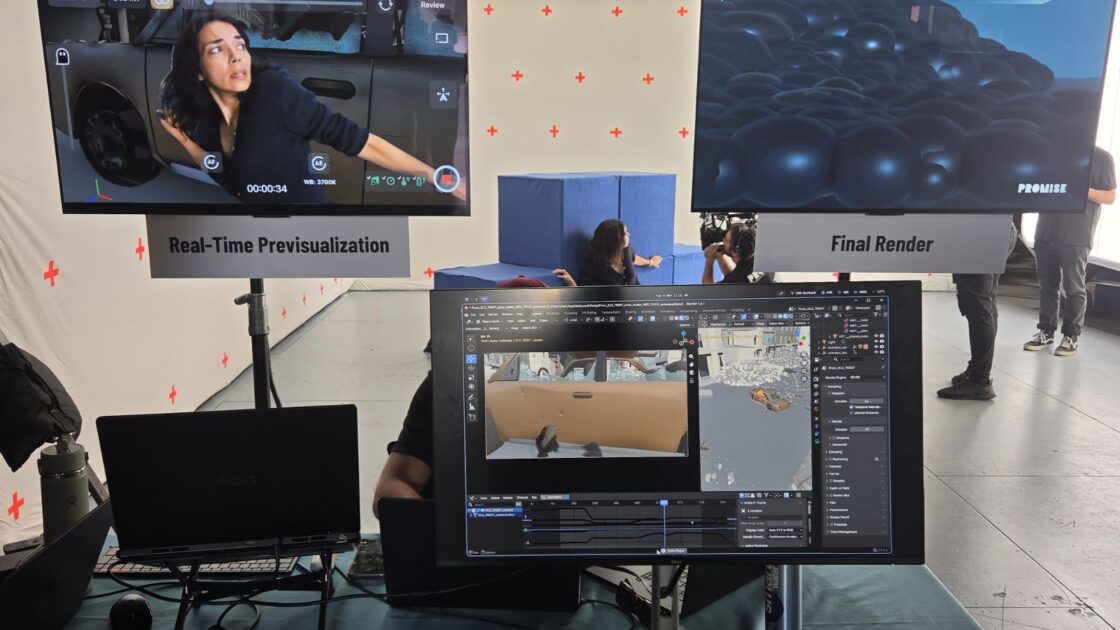
A new production technique is changing how scenes are filmed on Hollywood sound stages, replacing traditional green screens with neutral-colored enclosures known as gray boxes combined with artificial intelligence.
The Shift from Green Screens to Gray Boxes
Traditional green and blue screens have been used for decades in television and film production to allow crews to insert visual effects and backgrounds digitally during post-production. However, these bright colors can reflect onto actors’ skin and objects, and crews must continuously adjust backdrops whenever a director changes the camera angle.
Filming inside a neutral gray box offers greater flexibility for camera shots, as reported by CNET during a demonstration at a Disney sound stage in Los Angeles. When combined with artificial intelligence, the setup accelerates the post-production workflow, according to entertainment studio Promise Advanced Imagination, which showcased the technology during the Disney Accelerator Demo Day.
Dave Clark, co-founder and chief creative officer at Promise, explained that setting up shots takes significantly less time compared to green screen methods. This efficiency gives film crews more time to focus on creativity.
“You’re able to still capture the right performance and the right blocking … this allows me to just focus on the story, focus on the creative and not worry,” Clark told CNET. “You can get multiple takes because you can get them faster, you don’t have to worry about moving the crew, you don’t have to worry about changing lights, everything stays consistent so I can just focus on the story.”
Human Artists and AI Integration
While the gray boxes save time on set, additional time and cost reductions occur during post-production through the use of AI tools that assist in generating backgrounds, replacing lighting, and altering objects. Although some environments are entirely generated by AI, human 3D renderers and visual effects artists create most of them while utilizing artificial intelligence as part of their toolkit.
Clark emphasized that human artists oversee every step of the process. He noted that production begins with a script, moves to storyboards, and then proceeds to filming, relying on decades of traditional experience to amplify the technology.
The rise of artificial intelligence in filmmaking has raised concerns regarding potential job losses for actors, animators, writers, and set designers. Addressing these worries, David Min, vice president of Disney Innovation, told CNET that the system simply handles background generation—a task already performed by existing technologies like green screens—while allowing on-set personnel to concentrate fully on performance and direction.
Disney CEO Josh D’Amaro echoed this sentiment during the event, stating that technology serves as a tool for creators rather than the ultimate goal. George Strompoulis, CEO of Promise, detailed that the studio comprises four major components: Promise Studios for low-cost production, the Muse AI technology platform, the Curious Refuge AI Filmmaking academy, and The Generation Company visual effects business.
Rob Bredow, senior vice president of creative innovation at Disney, noted that the collaboration avoids the misconception of a single button creating an entire movie. Promise has already conducted testing with Disney teams and is currently producing a series pilot with another studio.
“The ability to do this at cinematic-quality level is something that we’re at the beginning stages of now,” Clark said.