

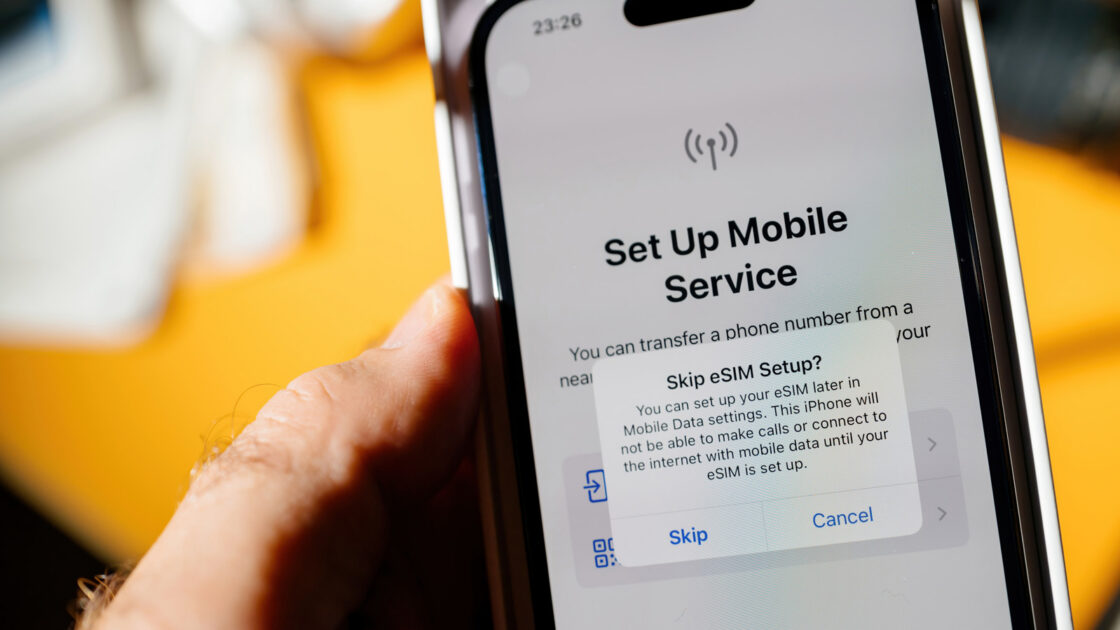
If you bought your phone in the past few years, it likely has eSIM support. An eSIM is a digital SIM built directly into your device, allowing you to activate a carrier plan without inserting an actual physical nano-SIM card.
How to check your phone for eSIM compatibility
The quickest way to check varies by operating system, but regardless of whether you have an iPhone or an Android device, you need to find an EID code. The presence of that code signals your phone supports eSIMs. On either platform, dialing *#06# from your phone app also pulls up the device information, including the EID.
Alternatively, if you use an iPhone, navigate to Settings, select General, go to About, and look for an EID, which is a 32-digit number tied to your eSIM chip. Apple states that you need an iPhone XS, XS Max, XR, or a newer model to add eSIMs, while iPhone 13 and later models can run two eSIMs simultaneously.
On an Android phone, open Settings, select About phone, and look under Device details or Status information for the EID. You can also go to Settings, select Network and Internet, or Connections on Samsung phones, and check SIM manager to see if an option to add an eSIM is available.
Compatibility limitations and unlocking
Not all phones support eSIM, as Android received eSIM support in 2017 and iPhones got it a year later. While iOS device compatibility is straightforward since they are made by one company, Android manufacturers adopted the technology at different times. The Google Pixel 2 and 2 XL received eSIM support in 2017, Motorola added support in 2019, and Samsung introduced it in 2020 with the Galaxy S20 series. Many budget or older Android models and region-specific variants skip the embedded chip entirely, making the EID check the most reliable method.
Your phone also needs to be unlocked to work when traveling abroad. If a device is locked to a carrier, it may still display an EID code because it can technically receive an eSIM from that specific provider, but it may refuse eSIM profiles from outside carriers. To check this on an iPhone, go to Settings, select General, go to About, and look for “No SIM restrictions” next to Carrier Lock. Users should also confirm their service provider supports eSIM activation.
If you remain unsure, contact your mobile network provider to confirm compatibility for your exact device. If your phone supports eSIM, dual SIM functionality allows you to run a traditional SIM alongside it, which is useful for keeping a personal and work number, or a home line and a travel plan, active on a single phone.