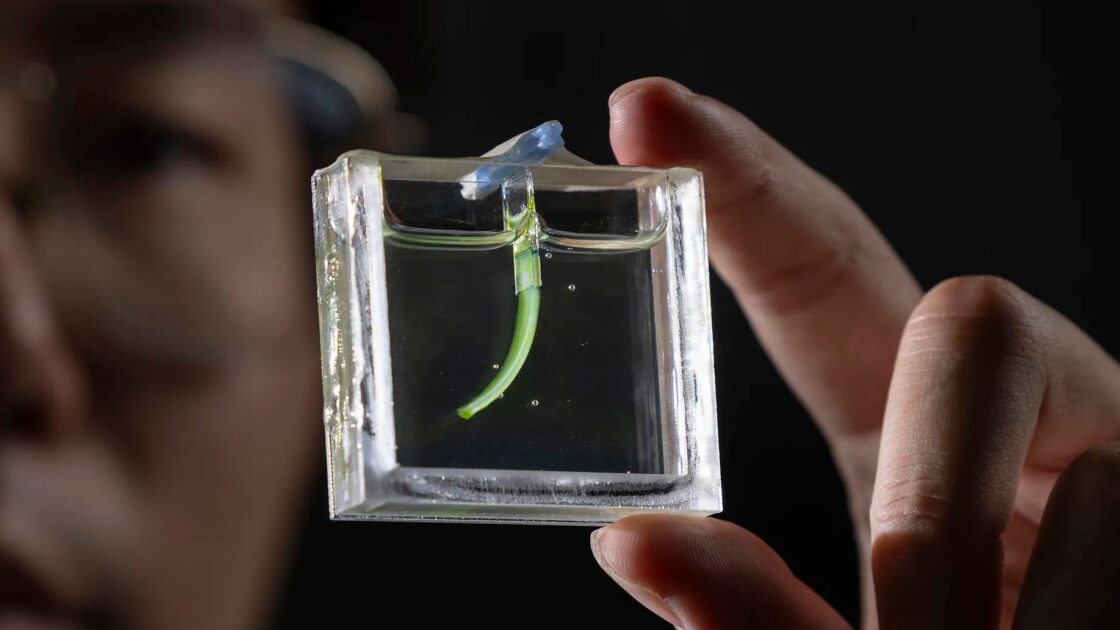
Researchers at Delft University of Technology in the Netherlands have developed soft robotic arms powered by algae on their surfaces, which move when the microbes undergo photosynthesis. These soft actuators flex and bend without metal or wires, using living cells to generate motion instead.
Designing Algae-Powered Soft Robots
The tiny robotic arms measure roughly three-quarters of an inch long and match the thickness of a credit card. They consist of two hydrogel layers housing algal cells. One layer reacts to pH changes driven by the metabolism of the algae.
When exposed to light, the algae photosynthesize, absorbing carbon dioxide and fixing nitrogen. This makes the local pH more basic and causes the hydrogel to swell. In the dark, the algae release carbon dioxide through respiration, shifting the pH back to acidic and shrinking the hydrogel. The varying volumes between the two hydrogel layers dictate the bending motion.
The research team noted that the pH-responsive layer shifted significantly depending on algal activity. In acidic conditions ranging from pH 3 to 7, the layer retained about 37 percent of its original weight, whereas it quadrupled in weight at pH 11. Unlike previous pH-responsive soft robots that required altering the chemistry of an entire surrounding liquid, the photosynthetic activity of the algal bots remains highly localized.
Capabilities and Future Applications
While the chemical shift starts rapidly—about 20 seconds after light exposure and roughly 10 seconds after darkness—the hydrogel requires several hours to bend significantly. Following their initial proof of concept, the research team built additional algal devices.
These included a four-fingered gripper that closes under light to grasp and lift a hollow metal sphere, releasing it when lights turn off, and a hook-shaped gripper capable of picking up and placing a rubber ring. Both items were extremely lightweight, and the arms handled them with high dexterity.
The robots operate without external energy sources aside from light and lack complex mechanical parts. Because the algae are self-sustaining plantlike organisms, the actuators hold potential for long-term operation with minimal external input. The algae do not require genetic modification, eliminating common biosafety concerns associated with microbe-based technologies while absorbing atmospheric carbon dioxide.
The research team aims for this technology to advance autonomous, environment-responsive soft robots suitable for automated agricultural equipment, fluid control in lab-on-a-chip devices, or underwater robotics systems.