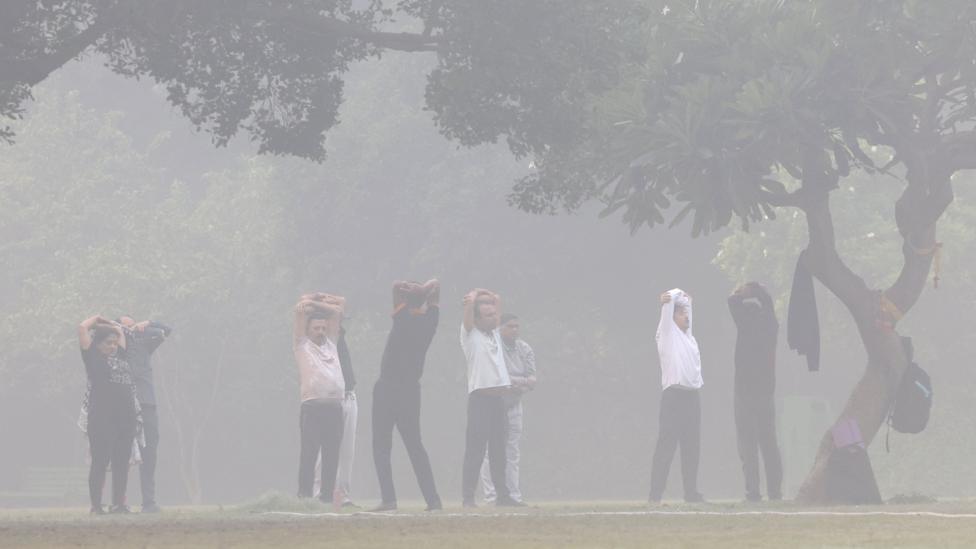
As winter approaches, residents of India’s capital are once again preparing for months of severe air pollution, with a grey haze and smoky smell returning to the city. While the Delhi government introduced its Winter Action Plan early this year, experts warn that stricter enforcement and broader sector targets are needed to tackle the crisis.
Winter Action Plan and Restrictions
The government’s Winter Action Plan runs from November 1 to February 28, a period when pollution typically peaks. Experts note this is a positive shift from previous years when measures were rolled out only after air quality deteriorated.
The governing Bharatiya Janata Party faces a major test of its campaign promises as the plan restricts older polluting vehicles from outside Delhi and bans fuel for vehicles lacking emission certificates. Outdoor construction and demolition work generating dust have been temporarily halted. To discourage private vehicle use, the government has asked offices to allow half of their staff to work from home, introduced staggered office timings, and doubled parking charges, alongside promises to strengthen enforcement and promote public transport and electric vehicles.
These actions operate alongside the Graded Response Action Plan (Grap), overseen by the federal Commission for Air Quality Management. Grap enforces stage-two restrictions this week, banning diesel generators, coal, and firewood burning.
Parthaa Bosu, a strategic adviser at the Environmental Defense Fund, notes that execution remains a challenge despite good planning. Manoj Kumar, an analyst at the Centre for Research on Energy and Clean Air, adds that the city must set emissions reduction targets for every sector—including power generation, industry, and transport—over the next five years. Bosu also highlights that secondary pollutants, dust, fly ash, brick kilns, and urban waste burning continue to worsen the problem, requiring coordinated regional action with neighbouring states.
Health Impact and Daily Disruptions
Government monitoring stations frequently record Air Quality Index (AQI) readings above 300 during winter, classified as “very poor,” while extreme days reach India’s maximum scale reading of 500. International trackers like IQAir have recorded levels near 1,000, and PM2.5 levels often exceed the World Health Organization’s recommended limits by more than 25 times.
Dr Manoj Goel, pulmonology unit head at Fortis Memorial Research Institute, explains that these tiny particles penetrate deep into the lungs and bloodstream, causing inflammation, throat irritation, coughing, and breathlessness, while worsening heart and lung conditions. A 2025 report by the Energy Policy Institute at the University of Chicago estimates air pollution could reduce life expectancy in Delhi by up to 8.2 years.
Daily life is further disrupted as border checkpoints create long traffic queues for commuters travelling between Delhi and satellite towns like Noida and Gurugram.
For residents like 43-year-old teacher Meenu Rana, who keeps windows closed, uses air purifiers, and relies on indoor plants, leaving the city is not feasible due to family jobs and schooling. “What option do we have? It is unfair but we will have to live with it,” she says.