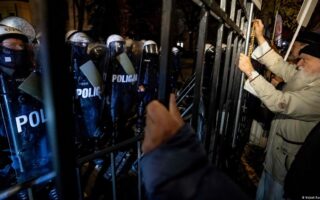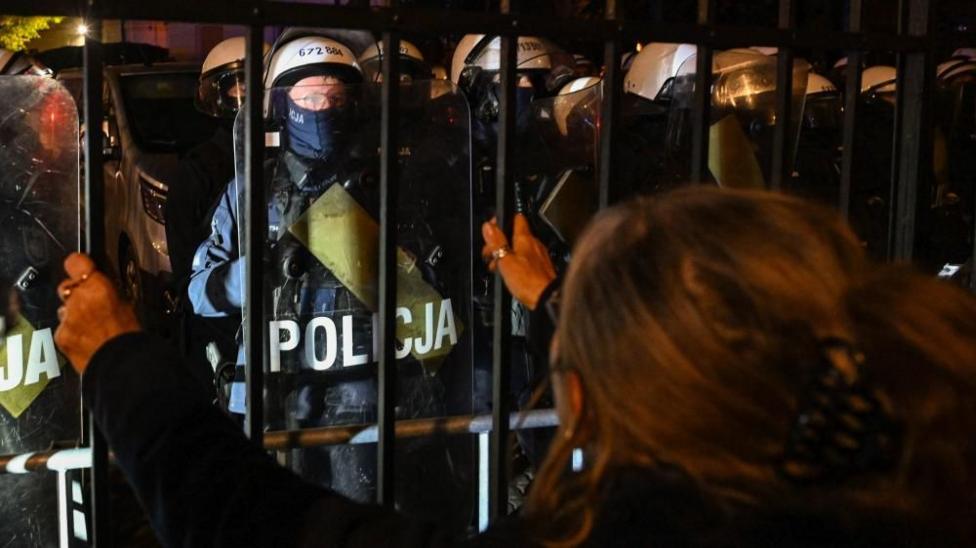
Riot police have been deployed at Poland’s Constitutional Court amid an escalating stand-off between the government and the court’s top judges. The political clash pits the administration of Prime Minister Donald Tusk against his predecessors from the right-wing Law and Justice party.
Government Action and Police Deployment
The police intervention took place after Justice Minister Waldemar Żurek announced he had requested the removal of immunity from prosecution for the court’s President Bogdan Święczkowski and Vice-President Bartłomiej Sochański in order to file criminal charges against them. Prime Minister Tusk defended the decision as supporters of the Law and Justice party gathered outside the court building in Warsaw to protest, stating that restoring the rule of law is a necessary duty following years of previous lawlessness. According to his chief of staff, President Karol Nawrocki, who is backed by the opposition party, entered the constitutional court after cutting short a trip to Senegal where he had been traveling for the Summer Youth Olympic Games. Riot police were positioned outside to prevent demonstrators from entering the building.
In a social media statement, the Constitutional Court asserted that the two targeted judges remain the legally appointed senior justices, warning that individuals participating in the government’s actions are committing the crime of a coup d’état. Meanwhile, Anna Korwin-Piotrowska, one of five judges elected by parliament since March whom President Nawrocki has refused to swear in, has been placed in temporary charge of the court. Earlier this month, the Venice Commission, the Council of Europe’s constitutional advisory body, stated that the president should administer the oath to the judges so they can sit on the bench. Justice Minister Żurek argued that Święczkowski and his deputy should face criminal charges for preventing those judges from adjudicating.
Historical Context and Criticism
The Law and Justice party took power in 2015 and quickly appointed judges to secure a majority on the tribunal, which holds the authority to determine the legality of legislation. Major European courts subsequently ruled that the party had improperly elected three judges and declared that Poland’s Constitutional Court was no longer an independent and impartial tribunal, prompting Tusk’s government to stop publishing its rulings. Tusk has faced challenges in reversing these judicial changes due to presidential vetoes and Nawrocki’s refusal to swear in new judges. While some supporters have criticized Tusk for not acting decisively enough ahead of parliamentary elections scheduled for next year, his recent measures have also drawn sharp criticism from legal experts.
Lawyer Marcin Matczak, a critic of previous judicial reforms who considers Święczkowski to be the court’s worst president, stated that the suspension lacked any legal basis. Warning that the confrontation would harm the rule of law for years to come, Prof Matczak wrote on social media that armed police and legal interpretations allowing a minister to remove the court president by decree would create a powerful anti-rule of law backlash.