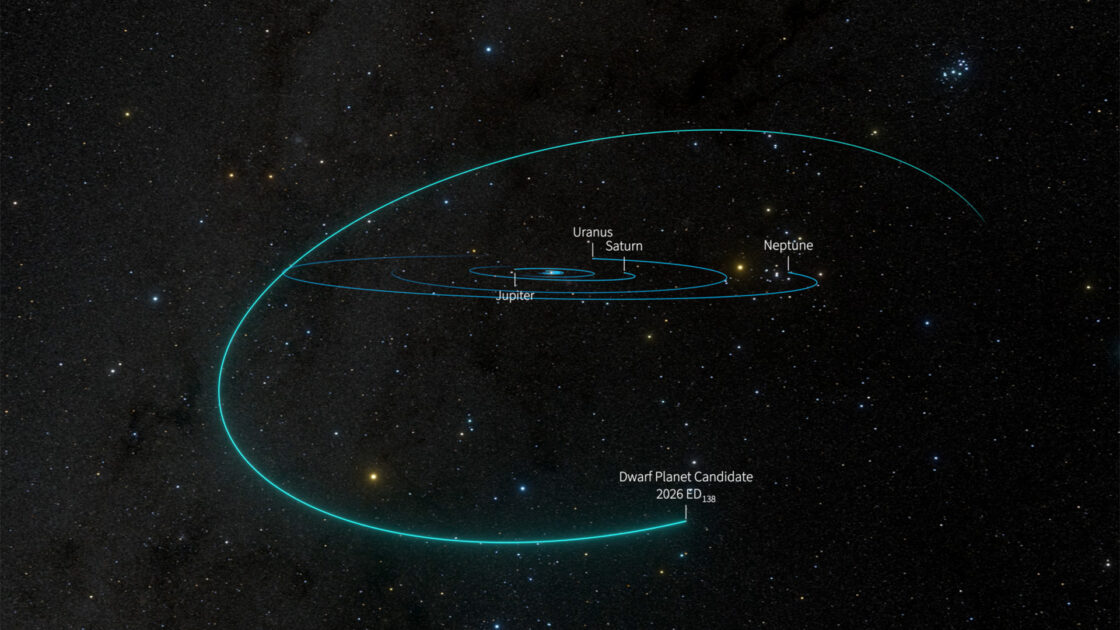
Scientists scanning space data have potentially discovered a sixth dwarf planet in our solar system, an extremely rare find among trillions of celestial objects. Researchers from the Vera C. Rubin Observatory identified the candidate, designated ED138, earlier in October using a program designed to scan for moving objects.
Discovering ED138
The object was first noted by Rubin Operations team member Matthew Holman, who expressed initial disbelief at the finding. Holman ran the search again through archived data and located the same object 20 additional times dating back to March 2026. Further checks using data from the Dark Energy Camera at the US National Optical-Infrared Astronomy Research Laboratory and the Asteroid Institute’s Asteroid Discovery Analysis and Mapping Precovery service revealed the object in observations reaching back to 2016.
Researchers are optimistic because ED138 possesses the key properties of a dwarf planet. Classified as a trans-Neptunian object, it resides further away from the sun than Neptune. Preliminary estimates indicate the icy body measures between 600 and 1,500 kilometers wide, providing sufficient mass for its own gravity to pull it into a round shape.
What Defines a Dwarf Planet?
Confirming ED138 as a dwarf planet would place it among a very exclusive group, as the Rubin Observatory has submitted 11,000 new asteroid discoveries since it began scanning the skies in June 2025. If officially recognized, it will join just five other celestial objects with this distinction: Pluto, Eris, Ceres, Haumea, and Makemake.
Dwarf planets must meet strict criteria. They must orbit the sun, not function as a moon, and possess enough mass to form a sphere via gravitational force. Crucially, unlike regular planets that absorb, eject, or gravitationally capture surrounding space debris to clear their orbits, dwarf planets share their orbital paths with numerous asteroids, comets, and other debris.
Finding such objects remains difficult because researchers often struggle to identify where to look amidst the vastness of space. ED138 orbits against the backdrop of the Milky Way, a crowded region filled with millions of stars, meaning previous telescopes likely captured the object while missing it among the background noise.
Mario Jurić, a member of the Rubin Solar System Operations team, stated in a release reported by CNET that the observatory provides an unmatched capacity to explore the sky using speed, depth, and precision. Holman noted that if the observatory can locate this object, additional discoveries are possible, suggesting ED138 may not remain the only such find.