Table of Contents
Experts say that celebrating Halloween does not require purchasing brand-new costumes or mass-produced plastic items that end up thrown away. Families can create imaginative and eco-friendly outfits using simple materials already available at home.
Finding Inspiration at Home
According to Cat Sewell, artistic director and co-CEO of Polyglot Theatre, the true thrill of Halloween comes from community connection, the fun of playing, and making ridiculous outfits rather than having a brand-new costume. Kristen Ahern, founder of Conscious Costume, notes that avoiding the commercial trap of franchises opens up a sense of freedom through everyday materials as reported by The Guardian.
Instead of buying craft store supplies, Ahern suggests looking at the essence of a desired character and using what is on hand. For example, individuals can dress in all green with attached leaves to become a nature spirit, or use a wire coat hanger and construction paper to craft animal ears. Another approach is “DisneyBounding,” which involves wearing everyday garments that emulate a favorite character’s color palette, such as wearing all green to represent Peter Pan.
Crafting with Packaging and Paper
Polyglot Theatre deliberately uses everyday materials to inspire creativity. Sewell explains that simple, open-ended items like paper, scrap fabrics, tea towels, and scarves allow people to create quickly without preciousness. Paper can be folded and twisted into various shapes, while thicker cardboards offer sculptural forms.
Packaging materials also work well for costumes. Cereal boxes can be painted or covered with aluminum foil and old wrapping paper to form robot heads or wild hats, while masking tape, rubber bands, and safety pins help hold pieces together. Ahern also recommends trading accessories and props with friends to easily create a new look.
Building Characters and Adding Gore
Layers, props, and makeup help complete a character and tell a story. Ahern explains that starting with basic clothing items like a white shirt and pants, and adding layered elements such as a bandana, eye makeup, and necklaces, transforms an ordinary look into a costume. Umbrellas can be modified with hanging decorations to resemble jellyfish, as noted by The Guardian.
Nick Wakerley, a costume designer at Cospro, points out that accessories like a black hooded cloak can represent multiple characters depending on whether it is paired with round glasses or a scythe. Everyday items like scarves, belts, and household hair and makeup products can easily alter ordinary clothing without needing to cut or ruin garments, such as using slicked-back hair and red lipstick to create a vampire.
Simple and Grotesque Ideas
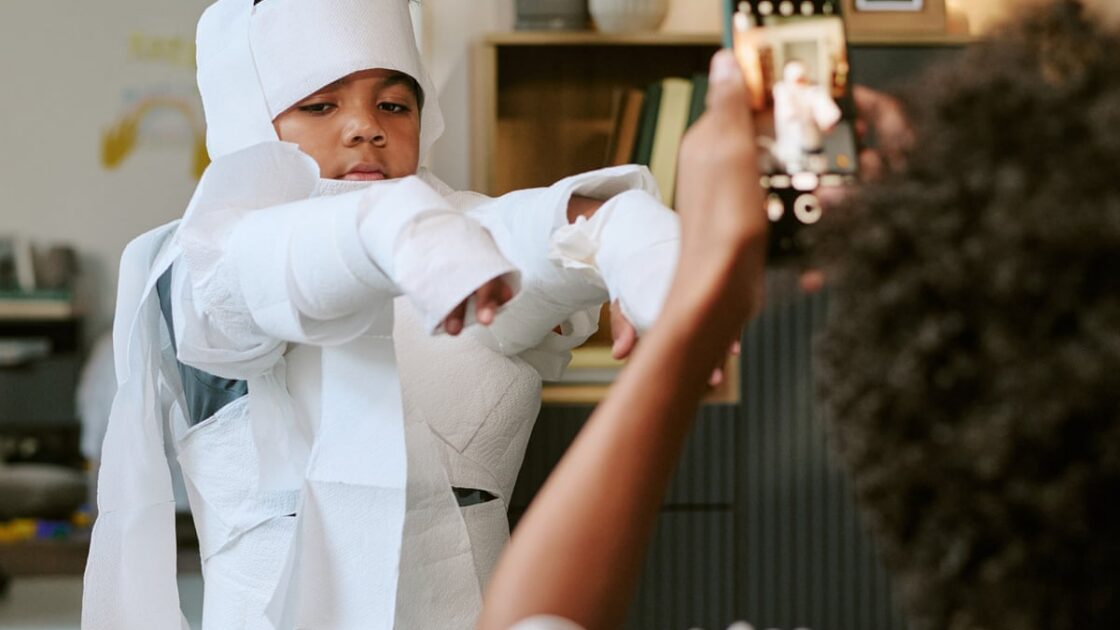
Costume designer Paula Levis states that combining dress-up boxes with items from medicine cabinets or hardware supplies can produce grotesque and amazing outfits. Children can be wrapped in old medical bandages to become mummies, or an orange jumper decorated with electrical tape can turn into a creepy jack-o’-lantern.
Basic black clothing paired with white masking tape can form a skeleton, while lipstick or food dye creates realistic bruising and blood effects. Levis emphasizes that parents do not need to rely on retail stores, encouraging them to believe in their own creativity using existing household materials. Sewell adds that reusing what is available benefits a child’s development, family connection, and the planet.