Table of Contents
While federal races often capture national attention, political parties and experts note that state legislatures carry immense power over everyday laws regarding education, taxes, and reproductive rights. Republicans currently hold majorities in 28 state legislatures, compared to 18 controlled by Democrats, while four are divided or share power.
Both Parties Assess Their Prospects
National party committees are actively targeting competitive districts. According to reporting by NPR, the Democratic Legislative Campaign Committee stated an aim to capture new majorities by leveraging anti-incumbent sentiment and the low popularity of President Trump. Meanwhile, the Republican State Leadership Committee acknowledged in an April strategy memo that 2026 presents a challenging political environment, prompting the GOP to adopt a defensive posture to protect its seats.
Democrats are investing millions of dollars to flip Republican-held chambers in key battlegrounds such as Wisconsin, Michigan, Arizona, New Hampshire, Minnesota, and Pennsylvania. Securing these chambers would grant Democratic governors greater leverage to pass policy priorities or block opposition initiatives.
The Stakes in Arizona, North Carolina, and Pennsylvania
In Arizona, Republicans maintain narrow majorities in both the state Senate and the House of Representatives. If Democrats flip both chambers, a reelected Democratic Governor Katie Hobbs could more easily advance stalled priorities, such as appointing agency leaders and rolling back school vouchers. In other states like North Carolina and Kansas, Democrats aim to break Republican supermajorities that currently override gubernatorial vetoes.
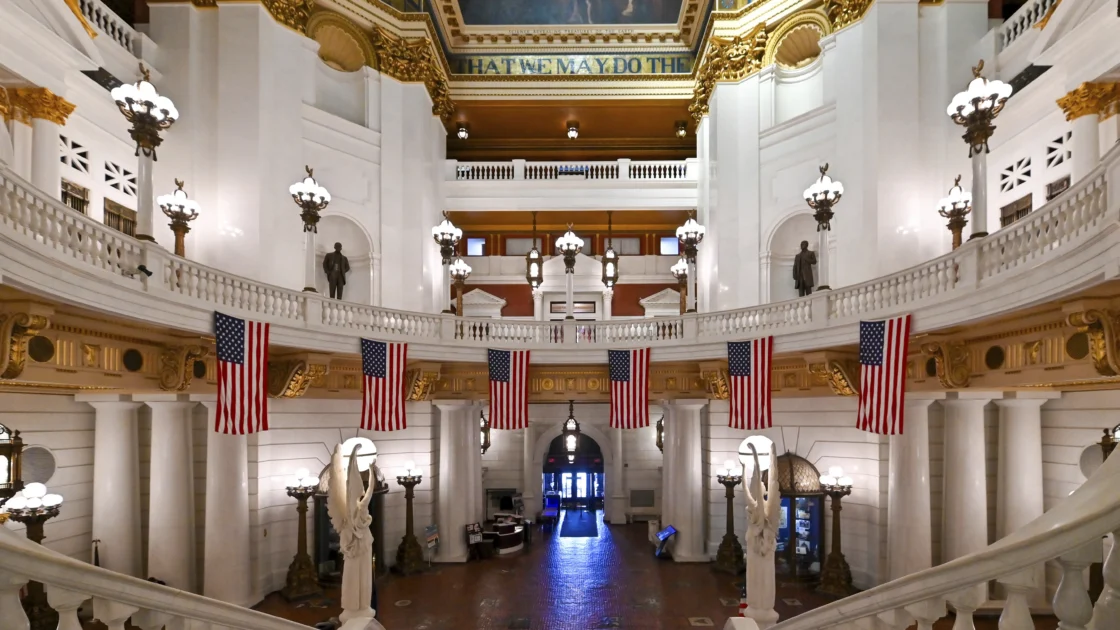
The potential for a major partisan shift is particularly strong in Pennsylvania, where Democratic Governor Josh Shapiro faces a split legislature. While Democrats hold a slim majority in the state House, Republicans maintain a four-seat advantage in the Senate. Pennsylvania has not seen a Democratic trifecta—full control of both the executive and legislative branches—in over three decades. The outcome could hinge on tight state Senate contests in the Philadelphia suburbs.
Policy Agendas and Campaign Debates
As he campaigns for reelection, Shapiro outlined an ambitious agenda if Democrats win full control, telling supporters at a rally that his administration would raise the minimum wage to $15 an hour, build affordable housing, tackle utility rates, and codify abortion rights into state law. While abortion remains legal in Pennsylvania, Republicans have blocked Democratic efforts to remove restrictions and clarify the statute against judicial interpretation.
West Chester University political science professor John Kennedy stated to NPR that Shapiro would likely pursue an aggressive legislative agenda, noting that the governor’s public image centers on being someone who achieves results. However, Shapiro’s Republican challenger, state Treasurer Stacy Garrity, criticized the governor during their sole public debate for blaming the divided legislature instead of negotiating.
In New Hampshire, Democrats are similarly working to win a majority in the 400-member state House to establish a check on Republican Governor Kelly Ayotte, who is running for reelection. Kennedy noted that the current Republican dominance in many statehouses dates back to sweeping wins during the 2010 midterm cycle, which allowed the GOP to solidify control through redistricting. Depending on upcoming election outcomes, victorious parties in the next cycle could use redistricting to further reinforce their gains.