Table of Contents
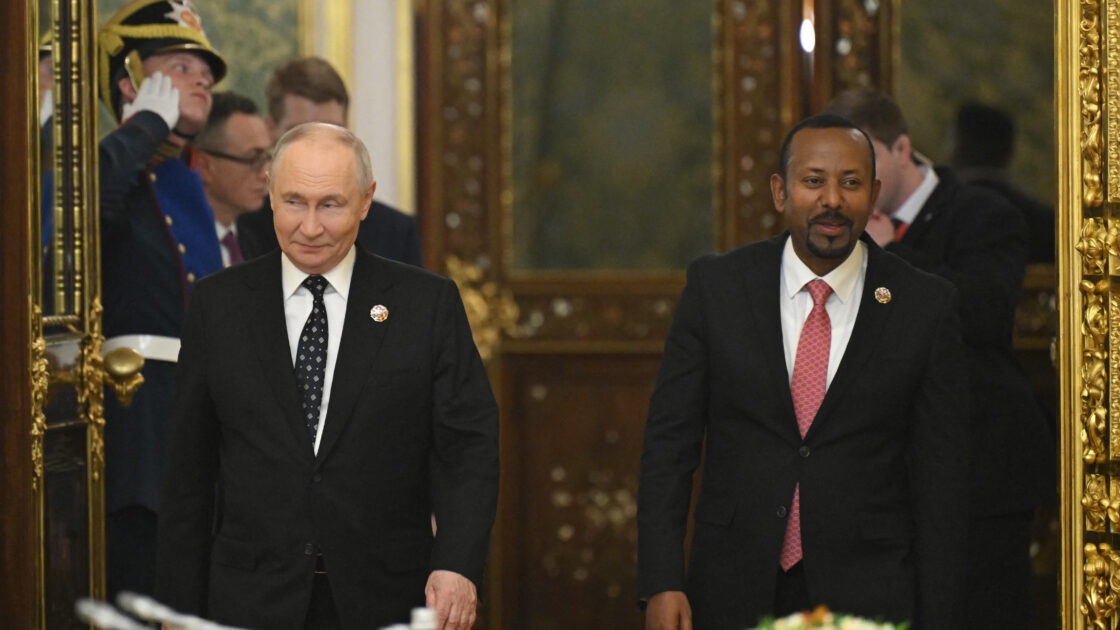
Ethiopia has received 12 Russian Su-35 fighter jets and will acquire four S-400 air defence batteries. Prime Minister Abiy Ahmed announced the agreement in Moscow during the two-year Russia-Africa Summit, a deal experts say strengthens Moscow’s influence in the Horn of Africa while reinforcing Addis Ababa’s military capabilities.
Military Cooperation and Weapon Deliveries
Abiy stated that Ethiopia took delivery of its first 12 Su-35 fighter jets under an earlier agreement with Russia, with four S-400 air defence batteries scheduled to follow later, though he did not specify an arrival date for the air defence systems. The new aircraft expand an existing Ethiopian air force fleet that already utilizes Russian fighter jets, while the S-400 systems will provide additional protection against aerial threats.
Benedict Manzin, a lead analyst on the Middle East and Africa at risk consultancy Sibylline, told Al Jazeera that the systems would be best deployed against conventional air threats. He noted that in a potential war with Eritrea, the equipment could target a limited air force and drones, though he cautioned that conventional air defences can still be overwhelmed by small and inexpensive drones based on observations from Ukraine.
In his official statement, Abiy thanked Vladimir Putin for ensuring the aircraft arrived a year ahead of schedule, noting that the equipment enhances Ethiopia’s capability to preemptively deter aggression. Russian President Vladimir Putin also praised the relationship, stating that Russia and Ethiopia stand together in international affairs.
Geopolitical Strategy and Economic Ties
Experts explain that the agreement builds on decades of military cooperation originating from the Cold War era, when the Soviet Union backed Ethiopia’s former communist government. According to the Ethiopian News Agency, current military agreements aim to upgrade Ethiopian armed forces through technology, knowledge, and training.
Beyond military strategy, commercial interests play a major role in the partnership. Manzin told Al Jazeera that Russia generates revenue through arms sales, which remain one of its primary exports to the African continent and help sustain ongoing relationships that require maintenance, training, and replacement parts.
During their discussions, Abiy and Putin covered broader areas of cooperation including nuclear energy, health, trade, agriculture, industry, and education. Putin reported that bilateral trade surpassed $1.3bn between January and September, more than double the total figure for 2025.
Manzin observed that Ethiopia is expanding its diplomatic and military options rather than committing exclusively to Moscow, maintaining a significant Chinese presence and ongoing Western investments alongside its Russian ties. Data from the Stockholm International Peace Research Institute shows that Russia supplied 15 percent of major weapon imports to Africa between 2021 and 2025, trailing the United States at 19 percent and China at 17 percent.
Domestic Conflicts and Regional Tensions
The weapons delivery coincides with renewed fighting in the Tigray region, a separate rebellion in Amhara, and rising tensions regarding a potential conflict with Eritrea. Manzin noted that the timing aligns with active domestic conflicts where the air force has been heavily utilized for military suppression.
Hostilities between the federal army and Tigrayan forces intensified in late September, effectively dismantling the November 2022 Pretoria peace agreement that had concluded a destructive two-year war. Both sides have accused each other of initiating the renewed violence following the establishment of a seven-group alliance aimed at removing Abiy’s administration.
Government and allied troops entered the Tigrayan capital of Mekelle in October after fighters from the Tigray People’s Liberation Front withdrew, leading Addis Ababa to establish a six-month caretaker administration while rebel commanders vow to persist with the conflict.