Table of Contents
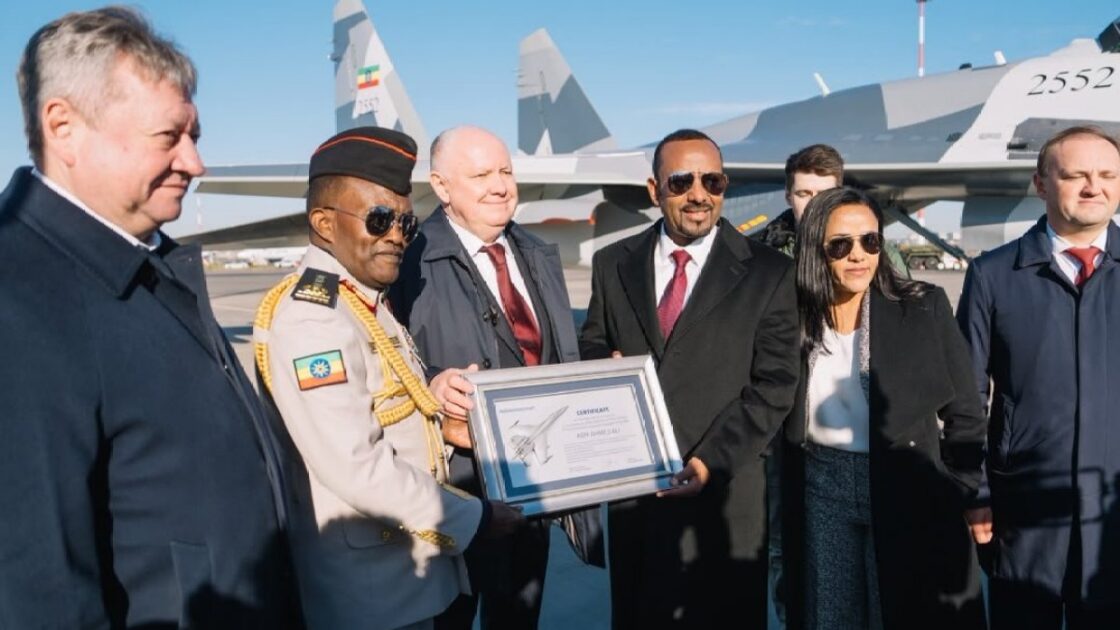
Ethiopia has taken delivery of 12 Russian Su-35 fighter jets and plans to purchase four S-400 air defence batteries, according to Prime Minister Abiy Ahmed.
Announcement in Moscow
Abiy announced the acquisitions on X on Wednesday while visiting Moscow for the two-day Russia-Africa Summit, where Moscow is working to build closer economic and security partnerships across the continent. The prime minister stated that the warplanes arrived a year ahead of schedule pursuant to a prior pact with Moscow, expressing gratitude to Russian President Vladimir Putin for expediting the shipment. He did not provide a timeline for the delivery of the S-400 systems, which are built to intercept aircraft and missiles.
Abiy noted that the hardware will bolster the country’s capacity to preemptively deter aggression. In a subsequent post on X that day, he characterized the aircraft as newly deployed additions tasked with protecting the nation’s airspace.
Growing Defense Ties
The deal reflects deepening military collaboration between Russia and Ethiopia following multiple pacts in recent years. Both administrations finalized a military cooperation pact in Addis Ababa in July 2021 designed to enhance the training and technology of the Ethiopian armed forces. Earlier in January, defense publication Janes noted that Ethiopia showcased newly obtained Russian Yak-130 advanced jet trainers during the air force’s 90th anniversary celebrations.
Data from the Stockholm International Peace Research Institute indicates that Russia accounted for 15 percent of major weapon imports to Africa from 2021 to 2025, positioning Moscow as the continent’s third-largest arms provider. Russia has pursued closer military and economic alignment with African nations amidst Western sanctions over its military action in Ukraine. The Russia-Africa Summit opened on Wednesday to convene African leaders for discussions covering trade, security, and investment.
Ongoing Domestic Conflict
The arms announcement arrives as Ethiopian troops engage in renewed combat against rebels in the northern Tigray region and face a separate insurgency in the neighboring Amhara region. The developments follow a significant shift in Tigray, where government and allied troops entered Mekelle, the regional capital, on October 4 after fighters belonging to the Tigray People’s Liberation Front (TPLF) retreated. The TPLF, a faction that previously administered the region, has experienced additional territorial setbacks as federal forces pushed into other towns.
Following these events, Addis Ababa installed a six-month caretaker administration for Tigray, though hostilities persist. A TPLF commander urged ongoing resistance via a television broadcast last week, and the group reported carrying out attacks against government-allied soldiers in northwestern Tigray on Wednesday. The renewed violence has effectively dissolved a peace accord concluded in Pretoria, South Africa, in November 2022 that brought a halt to two years of conflict. Researchers at Ghent University in Belgium estimate that the prior fighting resulted in approximately 500,000 civilian deaths. Meanwhile, federal forces are also engaged in combat against Fano, an Amhara militia that has fought government troops since 2023.