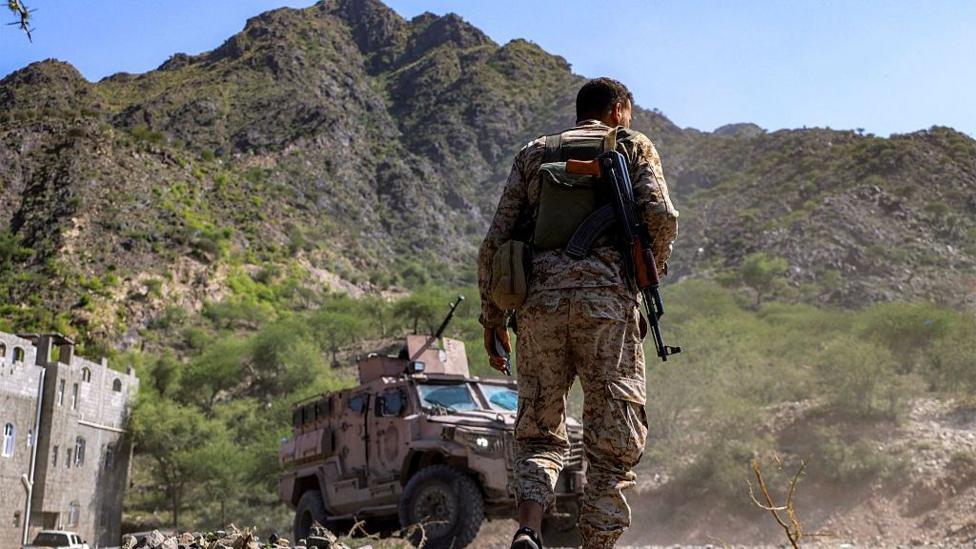
Yemeni pro-government forces supported by Saudi Arabia announced they are redeploying troops to protect the interim capital, Aden, following weeks of heavy combat with the Iran-backed Houthi movement. The Southern Armed Forces stated they are pulling back from a territory overlooking the critical Bab al-Mandab Strait at the southern edge of the Red Sea in order to shore up defenses around Aden and nearby regions. Houthi-controlled media reported that the movement has seized control of the vacated land, while Saudi Arabia has not issued any comments.
Retreat From Strategic Shipping Route
The troop movement concludes a weeks-long offensive aimed at securing the territory near the vital shipping lane that the Houthis captured during a sudden assault in September. Pro-government forces previously stated they secured the strait in early October to reclaim essential ground from the Houthis. A month prior, the Iran-backed fighters announced they had captured locations such as Perim Island located at the mouth of the strait along with the strategic port city of Mokha.
The Saudi-backed Southern Armed Forces, acting on behalf of the internationally recognized government of Yemen, declared on Sunday that the withdrawal aims to reinforce troops in other locations, designating Aden as a primary priority. The forces explained that troops are pulling back from Dhubab Airport and the Bab al-Mandab area to strengthen front lines and tackle active threats. The military stated that the priority remains securing Aden and neighboring governorates.
When the Houthis captured the territory overlooking the waterway, they asserted they presented no danger to international shipping transiting the route, though they vowed to persist in targeting vessels originating from Saudi Arabia. Nevertheless, the territory’s seizure triggered an increase in global oil prices because Saudi Arabia had depended on the Red Sea for oil shipments after the conflict involving the United States, Israel, and Iran effectively shut down the Strait of Hormuz.
Civilian Toll and Conflict Background
Ravina Shamdasani, a spokesperson for UN Human Rights, called upon all involved factions to safeguard civilians and civilian infrastructure. She pointed out that since the conflict escalated in August, more than 60 percent of recorded civilian casualties consisted of women and children.
The Houthis have launched continuous attacks against Aden over recent weeks, which included an October 15 assault directed at the presidential palace that resulted in five deaths and 16 injuries. In response, Saudi Arabia launched hundreds of air strikes, while the Houthis retaliated by firing hundreds of drones and missiles toward Saudi cities and infrastructure.
The United Nations estimates that nearly 330,000 individuals have been displaced throughout Yemen due to the escalating violence, with hundreds of fatalities reported. The country has suffered severe devastation from a civil war that commenced in 2014 when the Houthis removed the government from its capital, Sanaa. The conflict intensified significantly in 2015 when a coalition of Arab states led by Saudi Arabia intervened to reinstate the administration.
An informal four-year ceasefire began to disintegrate in July after the Houthis declared a maritime embargo against Saudi Arabia and initiated missile and drone strikes targeting Saudi airports, petroleum facilities, and tankers within the Red Sea. The Houthis stated their actions were in retaliation for a Saudi blockade affecting ports and airports within their territory, alongside an air strike on the Sanaa airport that they attributed to the kingdom.