Table of Contents
Amid a growing threat of renewed war, Washington is expanding its efforts to choke Tehran’s military supply networks by establishing Task Force Iron Gate to target land routes and the Caspian Sea. The United States Central Command (CENTCOM) announced the new unit on Saturday as part of an ongoing strategy to prevent Iran from using ground routes to transport advanced weapons and materials.
Purpose of Task Force Iron Gate
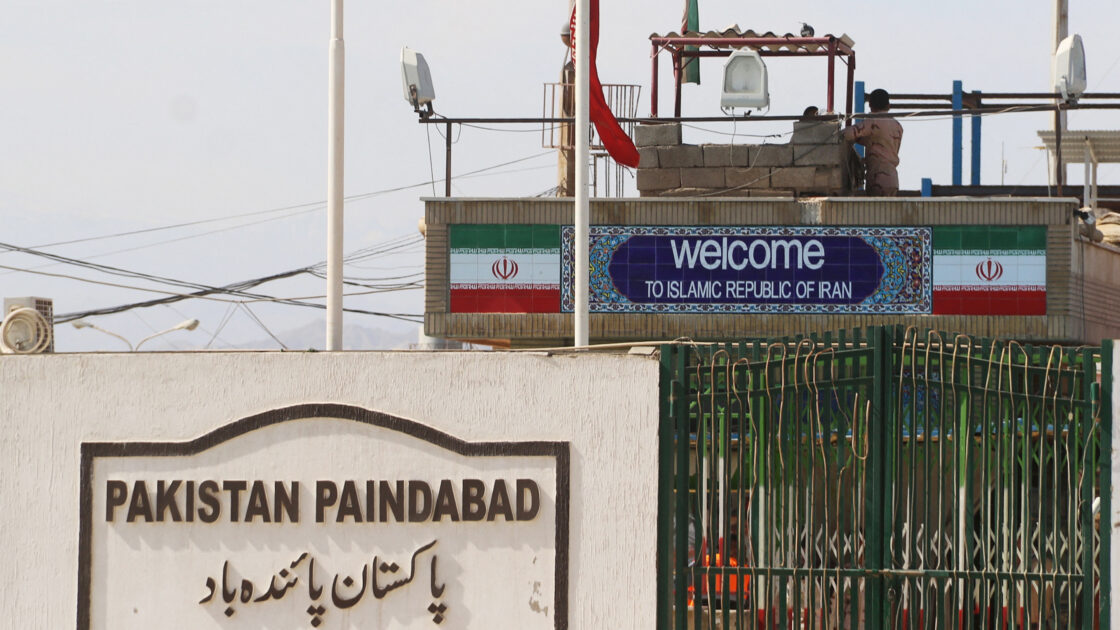
Task Force Iron Gate will focus on identifying where weapons systems arrive, how potential cutoffs can occur, and how Iran transports its energy, Michael Mulroy, a former US deputy assistant defence secretary for the Middle East, told Al Jazeera. The unit expands upon the existing US blockade of Iranian ports to cover Iran’s land borders and the Caspian Sea, and will reportedly operate with 20 civilian and military personnel.
Operating from its base in Tampa, Florida, the unit will coordinate with other US government agencies to prevent the movement of advanced weapons systems, dual-use technologies, sanctioned materials, and illegal revenue streams across Iran’s land borders and the Caspian Sea, CENTCOM stated. CENTCOM Commander Admiral Brad Cooper stated that Task Force Iron Gate will reinforce the success of the ironclad blockade against Iran at sea.
Mulroy stated that if US President Donald Trump escalates the conflict, attacks will likely target this series of targets. Mulroy explained that these targets will focus on economic and infrastructure elements rather than strictly military ones as part of a comprehensive plan to cut the regime off from its fighting and funding capabilities.
Iranian Response and Regional Analysis
The Islamic Revolutionary Guard Corps (IRGC) dismissed the military plan as merely a play on words. IRGC spokesman Sardar Mohebi stated, as reported by the Fars news agency, that Americans cannot achieve their goal of applying severe economic pressure to collapse and disintegrate the Iranian economy. Mohebi added that Washington previously claimed Iran would face economic collapse within two weeks, which did not happen.
While CENTCOM did not explicitly identify Iran’s weapons trade with Russia, analysts suggest the unit attempts to disrupt supply networks involving Russian connections. US media outlets reported that Russia has sent drone components and explosives to Iran via the Caspian Sea, alongside claims that Russian technology helps Iran develop advanced supersonic cruise missiles. Mahjoob Zweiri, a contemporary history and politics professor at Qatar University, told Al Jazeera that reports of military equipment imported via Russia represent a real concern for the United States, adding that the task force could cause a confrontation with Russia.
Rami Khouri, a public policy fellow at the American University of Beirut and a non-resident senior fellow at the Arab Center in Washington, stated that the US does not quite know what to handle regarding Iran and operates off the cuff with little success. Khouri pointed out that Iran’s thousands of years of history as a trading nation with an enormous web of contacts across Asia and the region makes sealing off every route virtually impossible for the US.
Impact and Policy Implications
Former Trump aide and top counterterrorism official Joe Kent, who resigned in March over the US war on Iran, posted on X that the new task force represents an attempt by CENTCOM to subvert ongoing diplomatic efforts while the vice president attempts negotiations. According to The Wall Street Journal, CENTCOM chief Cooper and Defense Secretary Pete Hegseth are among officials pressing Trump to renew attacks on Iran.
Zweiri noted that the task force might remain symbolic because the US lacks a military presence on the Caspian Sea and neighboring countries like Azerbaijan or Armenia are unlikely to collaborate due to concerns over upsetting Russia. Zweiri added that actions by the task force will not severely impact Tehran, given that the Caspian Sea accounts for only 11 percent of Iran’s economy. While Al Jazeera could not independently verify that specific figure, the New York City-based Soufan Center noted that the Caspian Sea accounts for only a fraction of Iran’s overall maritime trade.