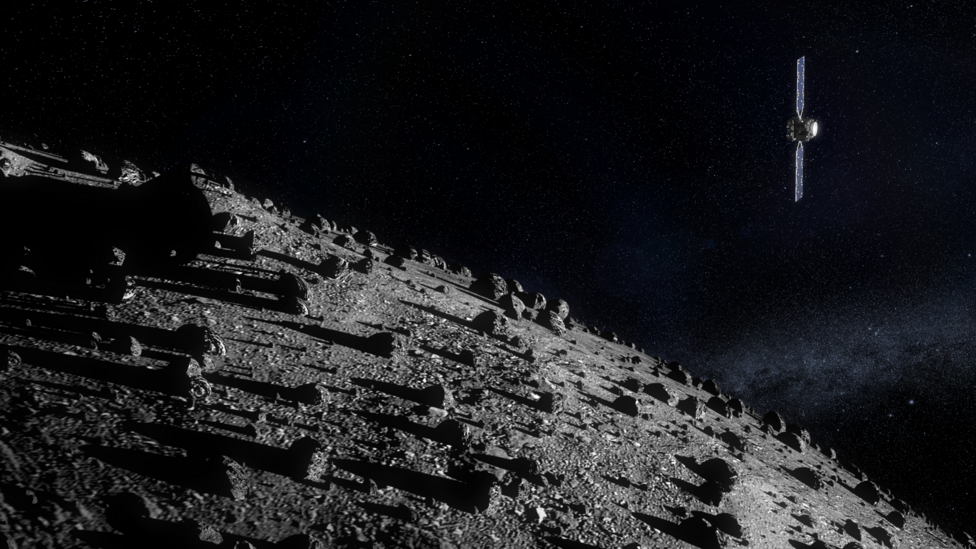
New images are set to be released showing the damage inflicted on an asteroid that was deliberately struck by a spacecraft four years ago in a test of Earth’s planetary defences. NASA’s DART spacecraft collided with the space rock in 2022 to knock it slightly off course, and the European Space Agency’s Hera mission has now arrived at the site to assess the aftermath.
Investigating the Impact Site
The target of the 2022 collision was a pair of asteroids consisting of a larger rock named Didymos, measuring approximately 730 meters wide, and a smaller orbiting rock named Dimorphos, which is about 150 meters wide. The DART spacecraft hurtled directly into Dimorphos at a speed of 22,000 km/h, obliterating itself on impact and creating a debris trail roughly 10,000 kilometers long that was observed by telescopes on Earth and in space.
Before the intentional crash, Dimorphos took 11 hours and 55 minutes to complete an orbit around Didymos, but the impact shortened its orbital duration by about 33 minutes. However, because DART was destroyed during the collision, scientists lacked detailed information regarding the final physical state of the asteroid. Patrick Michel, principal investigator of the Hera mission, likened the new spacecraft to a detective returning to a crash scene to investigate the outcome, noting that the impact may have left a crater or entirely reshaped the asteroid.
Future Planetary Defence Strategy
Over the next year, the Hera mission will study both Dimorphos and Didymos using an array of onboard instruments and two shoe-box-sized satellites that will examine the impact site up close before eventually landing on the asteroid. Measuring the mass of Dimorphos is a primary objective to determine the effectiveness of the spacecraft’s shove, providing critical data for predicting how to deflect future threatening space rocks.
While the largest asteroids capable of global devastation have already been mapped and pose no threat, and Earth’s atmosphere protects against the smallest debris, medium-sized asteroids comparable to Dimorphos remain a concern because many have yet to be discovered. Carolyn Ernst of the Johns Hopkins Applied Physics Laboratory emphasized the importance of identifying and stopping these potential hazards. Additionally, a new space telescope called the Near-Earth Object Surveyor will launch in 2027 to track hazardous asteroids, and upcoming missions by NASA, the ESA, and the Japanese Space Agency are scheduled to study the asteroid Apophis when it makes a close flyby in April 2029.