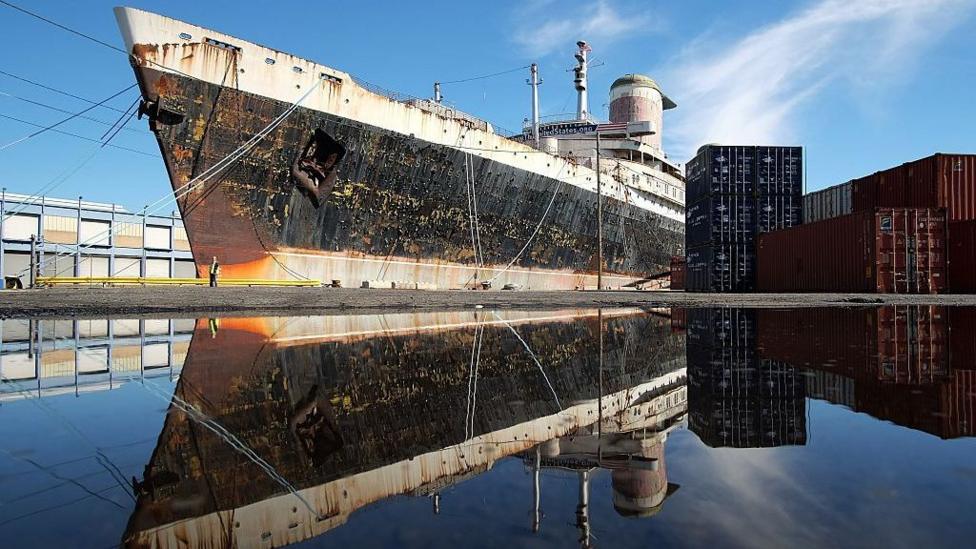
A vessel that once held the title of the world’s fastest ship and exceeds the length of the Titanic has been intentionally sunk off the Florida coast to transform into the world’s largest artificial ocean reef.
A Final Journey to Become a Reef
The SS United States remained docked in Philadelphia for nearly three decades before relocating to Florida, where it now provides a habitat for marine life and a destination for underwater explorers. Preservation activists previously campaigned to save the historic liner, which completed hundreds of Atlantic crossings, so it could operate as a museum. Those efforts fell short, and a Florida county ultimately acquired the vessel to sink it among dozens of existing artificial reefs, with plans to establish a land-based museum dedicated to its history.
The ship underwent cleaning and remediation work in Alabama last year after departing from Philadelphia. On Monday, it embarked on its final voyage from Alabama toward the coast of Destin, Florida, where a precision operation without explosives sank it on Wednesday.
Celebrity Passengers and Failed Preservation Efforts
In service from 1952 until its retirement in 1969, the vessel regularly transported royalty and prominent figures across the Atlantic between the United States and Europe. Notable passengers included a young Bill Clinton prior to his presidency, along with former commanders-in-chief Harry Truman, Dwight Eisenhower, and John Kennedy. Additional high-profile travelers during its operational years featured Marlon Brando, Coco Chanel, Duke Ellington, Salvador Dali, Walt Disney, Judy Garland, and Cary Grant.
Prior to the acquisition by local Florida government officials, several alternative plans to convert the ship into a museum or a floating hotel collapsed. The vessel spent years languishing at various docks under different owners amidst protracted legal disputes. The SS United States Conservancy organization made numerous attempts to prevent the sinking and keep the vessel afloat, though those campaigns ultimately did not succeed.
Conservancy President Susan Gibbs, whose grandfather contributed to the design of the liner, expressed satisfaction that the legacy of the vessel will endure. “[The ship] has always been this unabashedly American symbol that brings so many people together,” Gibbs stated in an interview with CBS News.