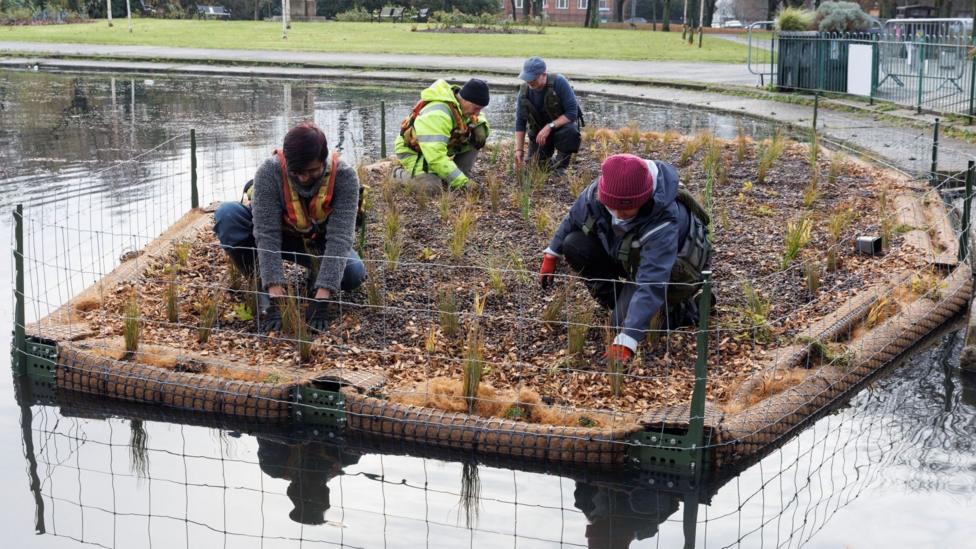
Floating nature islands are being installed on ponds across five public parks in Glasgow as part of the legacy for the 2026 Commonwealth Games. Local community groups are planting the islands, which are designed to boost local wildlife and improve water quality.
Boosting Habitat and Water Quality
The project will establish nearly 250 square metres of fresh wildlife habitat, which is anticipated to last for approximately two decades. Organisers of Glasgow 2026 are funding these installations as part of their pledge to deliver greener games. Ellen Hebdon, operations manager at the manufacturing company, explained that the roots of the plants play a crucial role in preventing and clearing harmful algae from the water.
“It’s not an overnight solution, but over a period of time, you will see benefits in the clarity and the cleanliness of the water,” she said.
The new islands are being placed in Victoria Park, Elder Park, Richmond Park, Queen’s Park, and Hogganfield Loch. Local schools and “friends of the park” associations are assisting with both the planting and ongoing maintenance of the sites.
Design and Wider Sustainability Efforts
The islands are constructed from recycled plastic materials, such as drinking water pipes, to provide buoyancy, and are fastened together with marine-grade stainless steel. A lightweight clay aggregate known as leca is placed on top, and aquatic plants are inserted into it. These plants feature a mixture of native evergreen and flowering species, including marsh marigolds, water forget-me-nots, and ragged robin.
The root systems beneath the floating structures offer shelter for aquatic animals, while their mid-water placement provides birds with undisturbed nesting spaces. The structures are produced by Biomatrix Water Solutions, a Forres-based firm in Moray that has previously exported similar installations to Boston, Venice, and London, in addition to an unrelated project on the River Clyde at the Glasgow Science Centre.
Selina Donald, head of sustainability for Glasgow 2026, stated that the city council had previously considered creating floating islands but lacked the necessary financial support.
“I really saw the pride in all the parks, the pride in the green spaces, the pride in the natural environment across the city,” she said. “And so really, for us, it was a way that we can celebrate and support that.”
Games organisers noted that sustainability remains a key delivery priority, with all competition venues powered by renewable electricity, and electric or hybrid vehicles comprising two-thirds of the transport fleet.