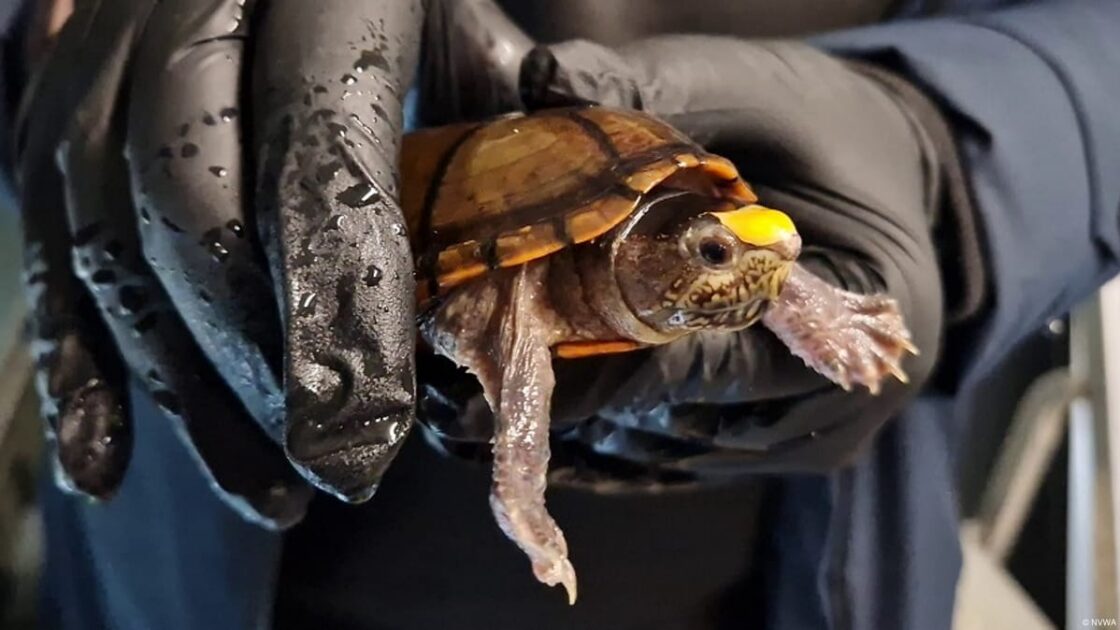
Dutch authorities announced on Friday that they seized 26 critically endangered turtles found inside a passenger’s luggage at Amsterdam’s Schiphol Airport. The animals were discovered during a customs check as the traveler prepared to board a flight to Hong Kong.
Discovery and Arrest at Schiphol
Customs agents found the live animals on November 21 during a routine inspection and subsequently notified the Netherlands Food and Consumer Product Safety Authority (NVWA). Following the discovery, police arrested the male passenger at the request of the NVWA, and federal prosecutors have kept him in custody while investigations continue.
According to the NVWA, most of the reptiles were packed inside a box together with a toy car, while others were stuffed into a sealed sock inside a suitcase. The animals had been wrapped tightly in duct tape to immobilize them, though authorities confirmed that every turtle survived the ordeal.
The rescued animals were transferred to a specialized rescue center where staff carefully removed the duct tape and provided necessary care.
Critically Endangered Species from Mexico
The seized animals are Vallarta mud turtles, which are endemic to western Mexico and were formally catalogued only in year 2018. They rank among the smallest turtle species globally, growing to no more than 10 centimeters or less than 4 inches in length.
The NVWA stated that these heavily protected animals were likely taken directly from the wild in Mexico, noting that only about 300 individuals of the species are estimated to remain in their natural habitat. Removing 26 of the creatures from the wild could have depleted the total wild population by nearly 10 percent.
Urbanization and the expanding tourist industry in the Mexican state of Jalisco have destroyed over 99 percent of the natural habitat of the species, according to estimates by the Austrian organization Turtle Island. Slow-moving and facing threats from traffic, their small size and striking appearance also make them highly vulnerable targets for illegal collectors, despite being classified as critically endangered by the IUCN Red List and receiving maximum protection under CITES.
The NVWA has encouraged the public to report any suspicions of illegal trade involving protected wildlife or plant species across online platforms, marketplaces, bird fairs, and antique markets.