Table of Contents
The administration of United States President Donald Trump has reportedly opted for gradual economic pressure on Tehran, maintaining a naval blockade, stringent sanctions, and overland border disruptions. US Secretary of State Marco Rubio informed Group of Seven counterparts in Paris that these measures could continue without a clear endpoint, predicting worsening conditions for Iran’s economy over the next one to three months.
Economic Pressures and Budgetary Scenarios
Tehran-based economist Isaac Saidian told Al Jazeera that if the persistent economic siege reduces Iran’s oil incomes to near-zero levels, the country will face one of the most difficult challenges in its recent history. Saidian noted that the core issue extends beyond declining foreign currency incomes to the government’s capacity to cover current expenditures, pay salaries and pensions, provide essential goods, protect the national currency, and prevent budget deficits from triggering a new inflationary wave.
Iranian President Masoud Pezeshkian indicated that the civilian government is preparing for a prolonged economic crisis, acknowledging that ongoing conditions remain harmful while stressing that economic collapse is not anticipated. In a budget directive on November 3, Pezeshkian’s administration outlined two scenarios: one featuring continued sanctions and maritime blockades, and another involving improved conditions with fewer commercial restrictions. Mohammad Ghasemi, deputy for coordination of planning and budget at Iran’s Plan and Budget Organization, told local media that the government must prepare for circumstances where oil revenue reaches zero.
Blockade Enforcement and Oil Production Declines
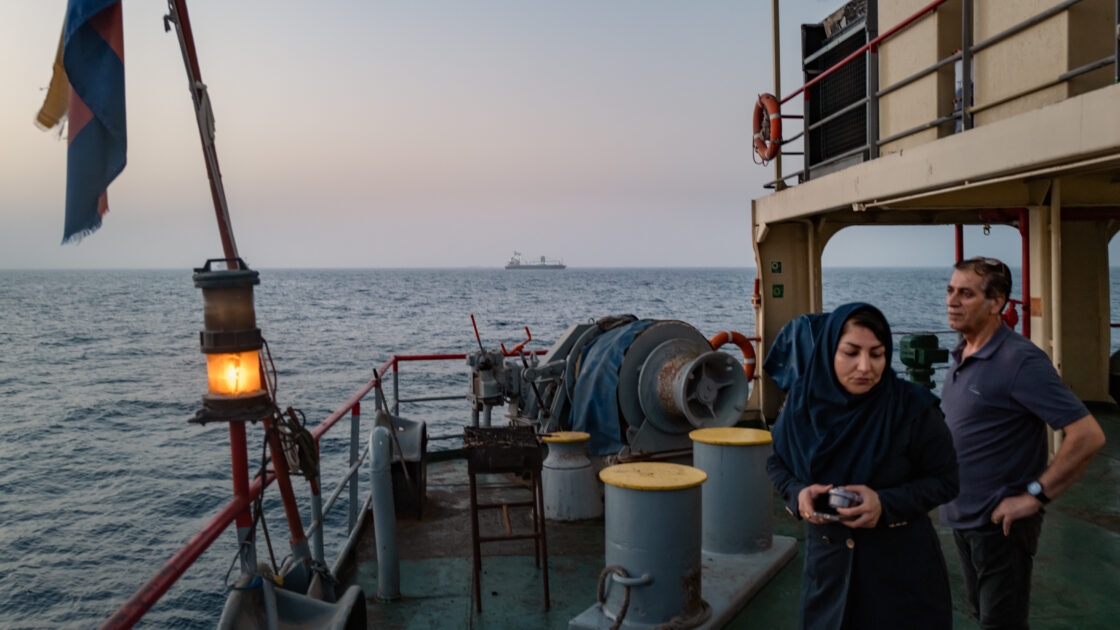
The US military first imposed a naval blockade on April 13, and following a brief interruption, a second blockade has been enforced since July 14 amid a dispute over control of the Strait of Hormuz. The US military reported redirecting 147 ships, disabling five, and destroying 10 Iranian oil tankers linked to the Islamic Revolutionary Guard Corps shadow fleet. According to the US Treasury, the blockade has resulted in zero oil being loaded onto vessels since August 25.
An October assessment by Kpler showed Iran’s oil production fell below 2 million barrels a day in the preceding months, down from roughly 3.5 million barrels per day at the start of the year prior to the outbreak of war on February 28. The volume of floating Iranian crude and condensate outside the blockade zone also dropped from 88.8 million barrels on July 14 to zero in mid-October. Additionally, US sanctions have limited air travel, and a new US task force aims to disrupt most land borders with Iran’s seven neighbours.
Reforms, Subsidies, and Inflation Concerns
With oil historically accounting for about one-third of planned government funding in the 2026–27 budget proposal, its removal will worsen chronic inflation, falling investments, and banking imbalances. Saidian suggested that if oil revenues drop sharply, the government should review public spending by cutting overlapping administrative structures, suspending low-return public investments, reforming tax exemptions, tackling tax evasion, and issuing bonds carefully. However, he cautioned that abrupt cuts to salaries or social support would deepen poverty, noting that the government may gradually reduce fuel and energy subsidies to manage the impact on inflation.
Government spokesperson Fatemeh Mohajerani stated that next year’s budget will prioritize inflation control through fiscal discipline, household support, and tighter bank oversight, while maintaining electronic food coupons despite runaway prices. Year-on-year inflation reached nearly 89 percent in the Iranian calendar month ending October 22, according to the Statistical Center of Iran.
Saidian emphasized that austerity measures cannot fully replace sustainable foreign trade and investment, stating that exiting inflationary stagnation requires reduced tensions. He added that the historical significance of the 2027-28 budget lies in testing Iran’s readiness to move beyond an oil-dependent economy and implement structural fiscal reforms.