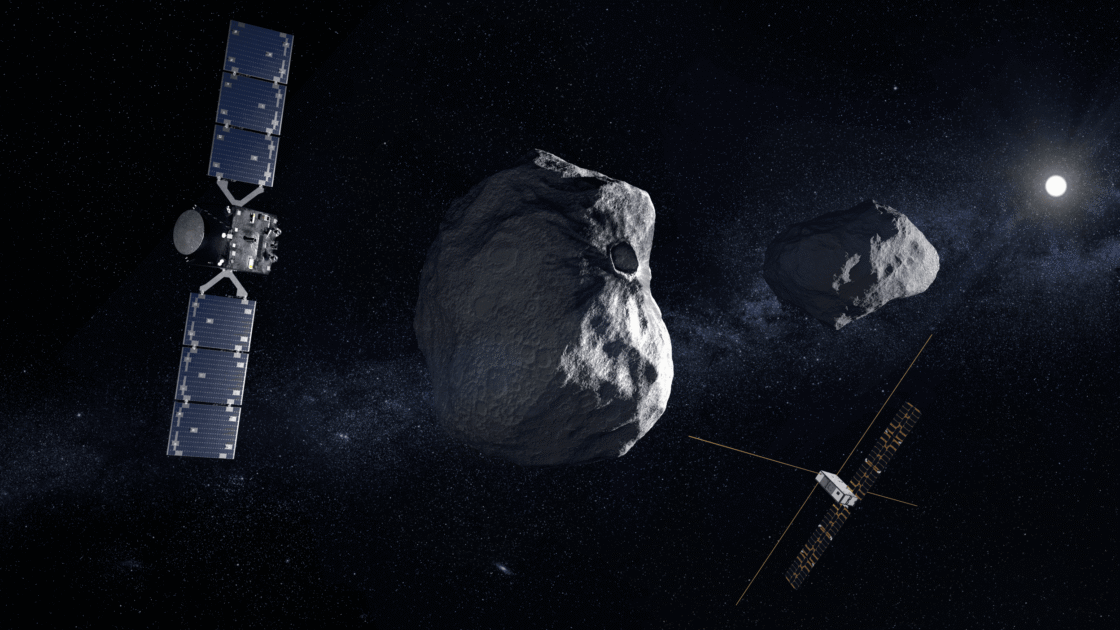
The European Space Agency’s Hera space probe has arrived at the binary asteroid system Didymos and Dimorphos to investigate the aftermath of a NASA planetary defense test. This close-range mission comes as scientists work to improve data and response strategies for near-Earth space rocks.
Studying the DART Impact Site
Four years ago, NASA tested asteroid deflection technology by launching the Double Asteroid Redirection Test (DART) mission toward Dimorphos, a small moonlet orbiting the 780-meter-wide asteroid Didymos. When the DART probe crashed into Dimorphos at over 13,000 miles per hour, it shortened the mini-moon’s orbit by 33 minutes due to a large recoil of ejected debris that also briefly gave the body a comet-like tail.
To examine the long-term impacts of this test, the European Space Agency launched the Hera probe in October 2024. Following a Mars flyby and arrival phase, the probe captured its first detailed image of Didymos in early November. As WIRED reported, the mission aims to determine the exact mass of Dimorphos to evaluate DART’s effectiveness as a planetary defense test while also studying the physical impact site to understand crater formation.
Advanced Exploration With CubeSats
Hera will map the topography of both asteroids using a lidar instrument and investigate their surface chemical compositions, capturing images with a resolution of 1 meter per pixel. Additionally, the mission will explore how binary asteroid systems form and study Didymos, which rotates every 2.3 hours near the edge of stability.
In January 2027, the probe will deploy two miniature cube-shaped satellites named Juventas and Milani to attempt surface landings. Juventas carries a radar capable of probing up to 100 meters deep and a gravimeter to measure gravity changes, while Milani will examine surface composition and search for dust and volatile substances.
The main phase of the Hera mission is scheduled to run until the summer of next year. These findings will provide vital insights as astronomers track near-Earth asteroids, the known count of which has grown from 300 in the year 2000 to more than 43,000 today.