Table of Contents
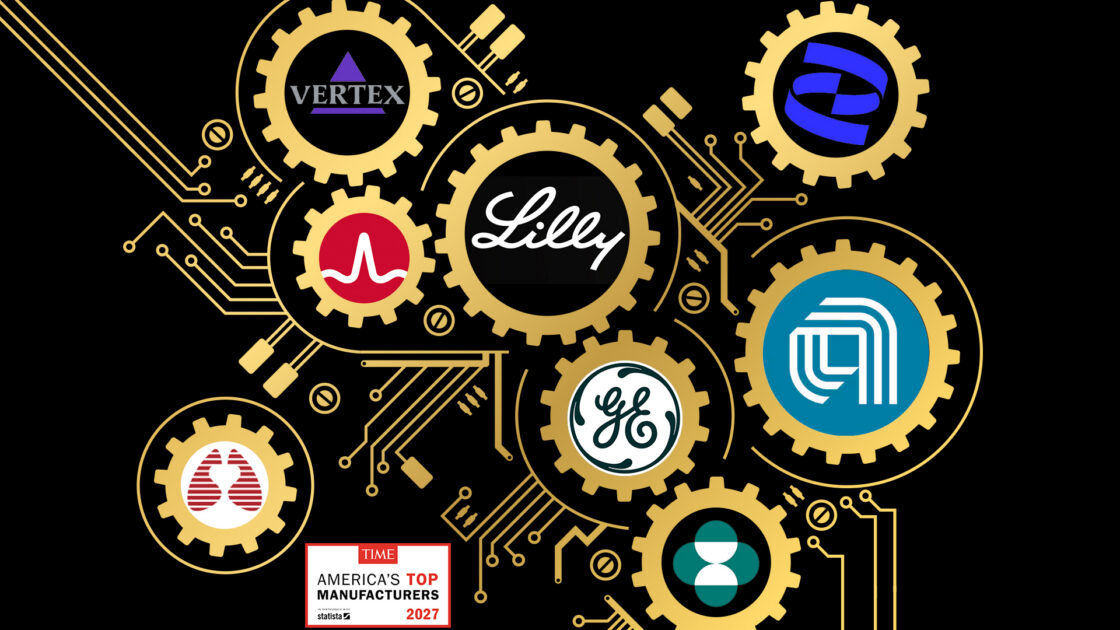
As manufacturing trends remain a central focus of American economic policy, TIME has partnered with data firm Statista to rank the top-performing manufacturing companies in the United States for 2027. While President Donald Trump’s global tariffs were implemented to encourage domestic production, analysts and think tanks remain divided on whether a true manufacturing boom is currently taking place across the country.
How the Top Manufacturers Were Ranked
To determine the ranking, TIME and Statista evaluated companies with at least $100 million in 2025 revenue that maintain production facilities in the United States. The assessment utilized company disclosures, public databases, and patent analytics, scoring businesses on their revenue growth and research and development expenditures between 2023 and 2025. Additionally, the methodology incorporated workforce growth, retention rates, and workplace safety records sourced from Form 10-K filings, ESG/CSR reports, and Occupational Safety and Health Administration databases.
The majority of the recognized companies fall within the industrial and electrical equipment sector, totaling 64 businesses, followed by 48 companies in electronics and semiconductors. Biopharma also holds a prominent position, accounting for 70% of the top ten entries. Eli Lilly leads the overall list as the first drugmaker to reach a $1 trillion market share, driven by high demand for its weight-loss medications. Backed by a $27 billion investment, Eli Lilly is constructing four new U.S. manufacturing facilities expected to generate 13,000 construction and manufacturing jobs.
Debating the State of American Manufacturing
A White House report published on Nov. 1 asserted that the nation is experiencing a manufacturing renaissance backed by $380 billion in investments for new plants. However, economic policy analysts at the Center for American Progress reported earlier in the year that 89,000 manufacturing jobs have been lost since the announcement of tariffs in 2025, noting that ongoing conflict in Iran has further strained supply chains and increased freight costs.
Author Rachel Slade argues that current domestic manufacturing momentum stems from prior legislative efforts under President Joe Biden, such as the 2021 Build America, Buy America Act, the Inflation Reduction Act, and the CHIPS Act enacted in 2022. Slade suggests that tariffs on raw materials and necessary components can inadvertently increase operational costs for domestic producers, complicating local manufacturing efforts.
J. Christopher Love, faculty co-director of the MIT Initiative for New Manufacturing, describes the sector as inconsistent rather than uniformly declining or thriving. Love notes that policy should focus on strengthening existing domestic capabilities with advanced technologies rather than attempting to replicate past manufacturing eras.
Growth in Electrical Equipment and AI Demand
The surge in data center construction, driven by the artificial intelligence boom, has propelled the electrical equipment sector to lead the TIME ranking. Among these companies is Generac, ranked at number 85, which Reuters reports is planning a $250 million factory expansion by late 2027 to produce specialized generators for data centers.
According to projections by analysts at Wood Mackenzie cited by TIME, the U.S. data center electrical equipment market is expected to expand from $20 billion in 2025 to $65 billion by 2030, ultimately representing 40% of the entire U.S. electrical equipment market.