Table of Contents
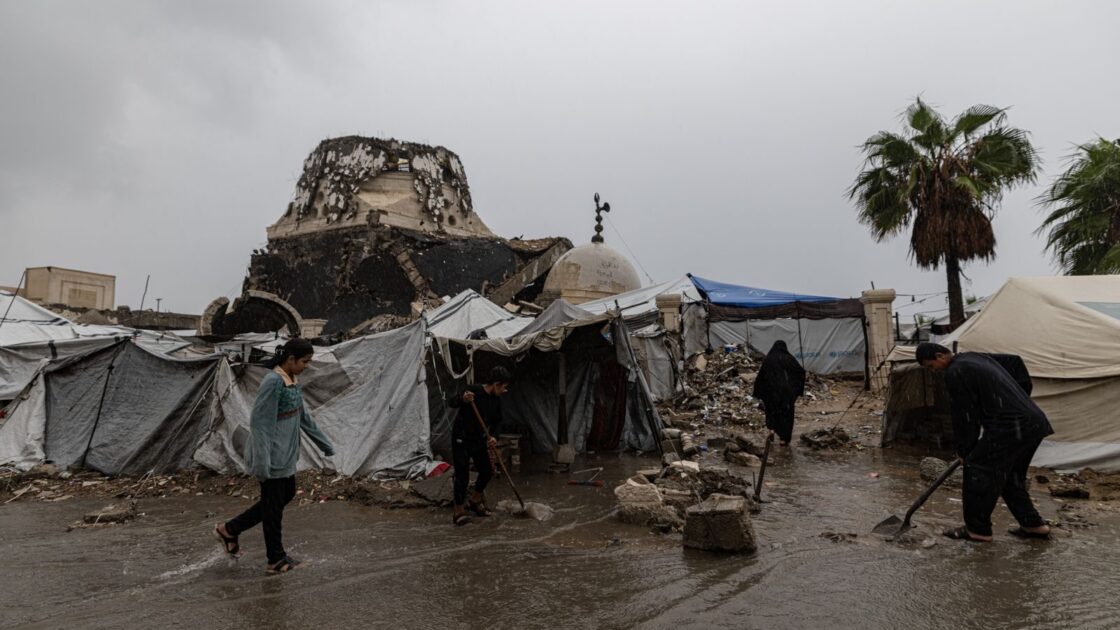
Heavy rain and strong winds have flooded displacement camps and battered damaged buildings across Gaza, leaving families struggling to keep their children warm and dry. Displaced residents in northern and central Gaza told Al Jazeera that the recent storm soaked their belongings, collapsed shelters, and heightened the danger of structural collapses in buildings damaged by air strikes.
Flooded Tents and Freezing Temperatures
Rana Adnan Hmeida, 29, spent the night awake with her husband and children at al-Mina camp in northern Gaza as rainwater flooded their tent. The family’s bedding, blankets, and clothes were completely soaked by water that seeped in as heavy winds battered the coast. Hmeida told Al Jazeera that her two-month-old baby and son were shivering and freezing in the cold.
Her husband, Sameh Hmeida, 30, noted that their tent lacked tarpaulins or insulation and was especially vulnerable due to its close proximity to the sea. Nearby, Raed Abu Amsha, 40, reported that his tent collapsed on his family during the two-hour storm, soaking the clothes and blankets of nine children in his care. He questioned how much longer they could endure such conditions without adequate tents and protective materials.
Water levels rose by 30 to 40cm (12 to 16in) at several camps, prompting hundreds of calls to Gaza’s civil defence agency. Al-Mina camp houses roughly 1,700 Palestinian families, leaving the ground covered in pools of muddy water.
Threats from Damaged Buildings
In central Gaza’s Nuseirat camp, rainfall has endangered residents living in permanent structures damaged by earlier bombardments. Nasser al-Hajj, 54, lives in a tower block struck in September 2025, where falling debris created a large hole in his ceiling that admits water during every rainstorm.
Although support beams were installed, an engineer warned al-Hajj that the apartment remains dangerous and could suffer further collapses if severe weather continues. During the storm, al-Hajj moved his children to a neighbor’s home and waited while debris fell from the roof, keeping his two autistic children in the building’s guard room away from the damage. He told Al Jazeera that high rental costs and unsafe tents leave him with no other options.
Humanitarian and Municipal Struggles
According to the United Nations Office for the Coordination of Humanitarian Affairs (OCHA), about 950,000 displaced people in Gaza reside in flood-prone areas, with more than 400,000 in high-risk locations. Furthermore, approximately 44,000 Palestinians live in structurally unsafe buildings, and over 4,000 structures require complete or partial demolition following air strikes. Shelter assistance is critically short, with available supplies covering only 18 percent of the needs for roughly 294,250 families.
Gaza Municipality spokesperson Hosni Muhanna reported that about 15 kilometers of rainwater drainage lines and 212 kilometers of sewage networks are damaged, while eight pumping stations and three main stormwater collection basins remain out of service. The crippled system can handle no more than 20 percent of rainwater under optimal conditions. Despite workers clearing drains, removing rubbish, and operating water pumps, severe shortages of fuel, equipment, and spare parts hinder recovery efforts.
Muhanna added that more than 2,000 buildings in Gaza City alone risk collapse, while the volume of rubble across the city has surpassed 25 million tonnes. Meanwhile, Adli Awad, an emergency committee official in Nuseirat refugee camp, stated that teams are distributing available tents and tarpaulins and helping families dig drainage channels, though the enormous need far outpaces current supplies.