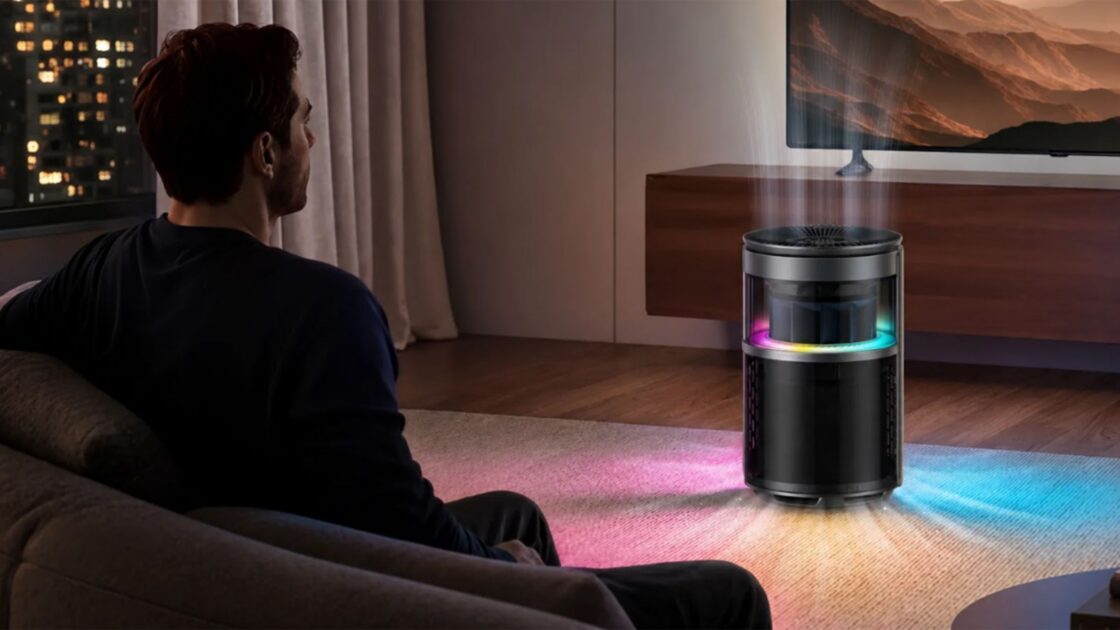
Air conditioning and electric fans currently consume approximately 20 percent of electricity in buildings worldwide, contributing to 3 to 4 percent of total greenhouse gas emissions. With the number of units expected to reach 5.5 billion by 2050, manufacturers are increasingly turning to radar sensors, AI, and heat pump technology to improve efficiency and reduce environmental impact.
The Rise of Intelligent Cooling
Modern air conditioners are moving beyond basic settings by using millimeter-level precision to track occupants. Companies such as Samsung, Dyson, Hisense, and Midea have introduced systems that detect movement to provide targeted cooling. For instance, LG’s DualCool AI AC utilizes a 5-meter radar sensor to identify movement patterns, while Hisense’s Companion Living AC uses smart home data to precool specific zones based on a user’s typical routines.
Dyson’s Find+Follow feature uses a low-resolution camera to map anonymous coordinates of occupants without employing facial recognition. According to Alex Hudson, an environmental care engineer at Dyson, the device can distinguish between sitting and standing positions and oscillate 350 degrees to direct airflow. When the room is empty, the unit automatically shifts to a lower power mode.
Samsung’s Bespoke AI WindFree Pro incorporates motion radar to track up to two people, offering both direct and indirect airflow options. The company claims its AI energy mode can reduce consumption by up to 30 percent. Meanwhile, Midea’s upcoming VitaBreeze AC, set for a 2027 launch, combines user-uploaded room images with millimeter-wave (mmWave) radar to create a 3D virtual grid of the space. Manuel Seethaler, head of Midea’s Residential Air Conditioning product strategy in Europe, states that this technology can achieve energy savings of over 30 percent compared to standard models.
While these features aim to improve comfort and efficiency, experts remain cautious about the scale of the impact. Björn Palm, a senior professor in energy technology at the KTH Royal Institute of Technology, notes that while targeted cooling has the potential to lower energy use, the exact savings remain unclear. Vincent Romanin, founder and CTO of Gradient, expressed skepticism regarding the practical effectiveness of occupancy sensors, suggesting that the industry should focus more on fundamental hardware improvements.
Compact Heat Pumps and Refrigerants
To achieve sustainable cooling by 2050, Palm argues that the industry must prioritize three areas: developing cheaper, compact heat pumps for smaller homes; transitioning to natural, non-toxic refrigerants; and designing systems with low charge to ensure safety. Heat pumps, which function by absorbing and compressing heat, offer an efficient alternative for both heating and cooling.
Gradient is addressing the need for apartment-friendly solutions with compact, self-install window units that use one-third less energy than standard models. However, replacing synthetic refrigerants with natural alternatives like propane—as seen in Bosch’s Climate 6000iP—presents significant engineering hurdles. Because natural refrigerants are flammable, they require complex, spark-free designs that currently face regulatory caution in the United States.
Leaking refrigerants are responsible for an estimated 720 million metric tons of CO2-equivalent emissions annually. Palm emphasizes that while smart tracking features may offer convenience, the long-term future of cooling depends on the mechanical efficiency of compressors and the transition to safer, natural refrigerants.