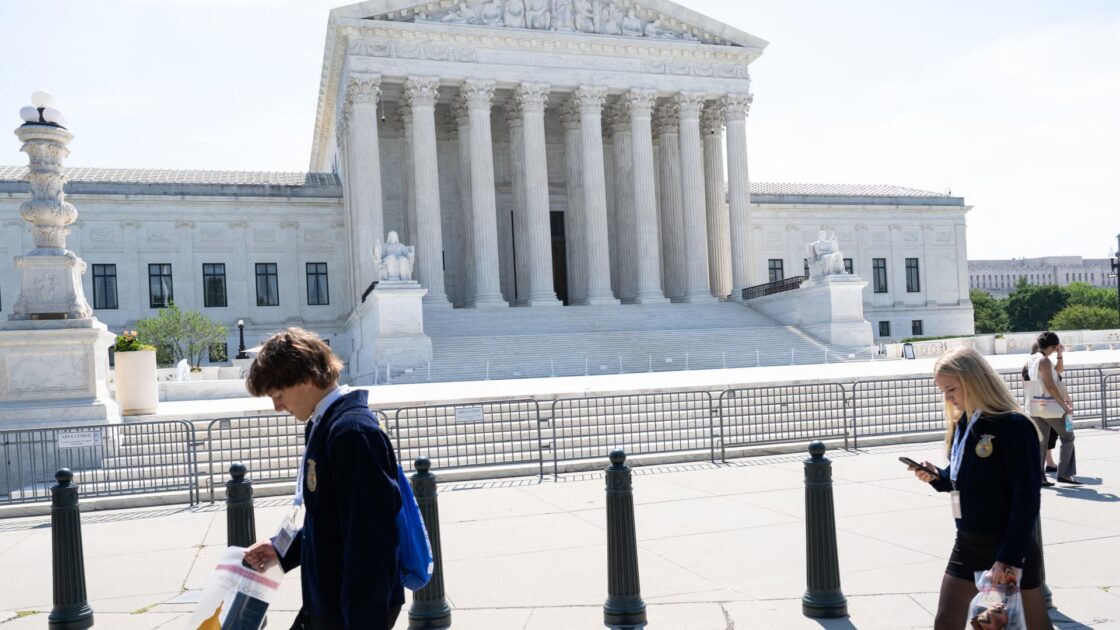
The United States Supreme Court is set to hear arguments on whether state and local assault weapons bans violate the Second Amendment’s right to keep and bear arms. Nicole Hockley, who co-founded Sandy Hook Promise after losing her 6-year-old son Dylan in the 2012 Sandy Hook Elementary School shooting, is heading to Washington alongside other families and survivors of mass shootings as the conservative-majority court takes up the hotly contested issue.
Legal Battle Over AR-15-Style Firearms
Gun rights advocates supported by the Trump administration argue that banning the nation’s most widely owned rifle is unconstitutional, noting the firearm is involved in a relatively small portion of overall gun violence. Bill Sack, senior director of legal operations at the Second Amendment Foundation, described the case as the “Super Bowl of gun rights for the time being” as reported by US Top News and Analysis (cnbc.com).
Approximately a dozen states have enacted laws banning weapons like the AR-15, covering major metropolitan areas such as New York, Los Angeles, and Chicago, where a county-level ban is also under review by the high court. A federal law restricting the sale and manufacture of these firearms expired in 2004, after which the weapons surged in popularity and became widely available at lower prices. Retailer surveys cited in court documents show sales of AR-15-type weapons rank second only to semiautomatic handguns.
These rifles have been used in several high-profile mass shootings, including attacks at an elementary school in Uvalde, Texas, a country music festival in Las Vegas, and an Independence Day parade in Highland Park, Illinois. Sheila Gutman, who was wounded during the July 4, 2022, parade shooting in Highland Park where a gunman fired 83 rounds in under a minute and killed seven people, stated she had no idea the damage the weapon could cause after suffering a baseball-sized wound to her foot that required 17 surgeries and leaves her walking with a limp and constant nerve pain.
Impact on Gun Violence and the Second Amendment
Data from James Alan Fox, a Northeastern University criminology professor who maintains a mass killing database in partnership with The Associated Press and USA Today, shows that America’s deadliest mass shootings have frequently involved semiautomatic rifles. Such attacks have killed nearly twice as many people on average as other mass shootings, with Fox noting that assault weapons impact the level of carnage even if they do not change the likelihood of committing the crime. However, Fox added that handguns remain more prevalent in overall gun violence and the majority of mass shootings.
Adam Winkler, a law professor at the University of California, Los Angeles, questioned the broader public safety impact of the upcoming decision, stating he does not believe it will affect gun violence significantly either way, though he acknowledged the ruling could heavily impact other firearms laws. The upcoming case follows a landmark 2002 Supreme Court decision by its conservative majority that expanded gun rights and mandated that firearm restrictions must be rooted in the nation’s history, which triggered widespread legal challenges and left lower court judges confused about applying the new test.
Challengers cite a 2026 survey estimating that Americans own roughly 40 million AR-15-type rifles, making them more common than Ford F-Series pickup trucks. The administration and gun rights advocates argue that while bans on weapons like machine guns have historical backing, there is no similar basis for restricting weapons in common use by law-abiding citizens. Conversely, defenders of the laws in Connecticut and Illinois maintain that the firearms were originally designed as weapons of war and fire high-velocity rounds that inflict catastrophic damage to the human body. Attorneys for Connecticut and Cook County, Illinois, argue that millions of sales do not exempt these weapons from state regulations enacted by democratically elected lawmakers once a weapon poses an unacceptable threat to human life.
A decision from the Supreme Court is anticipated around the end of June.