Table of Contents
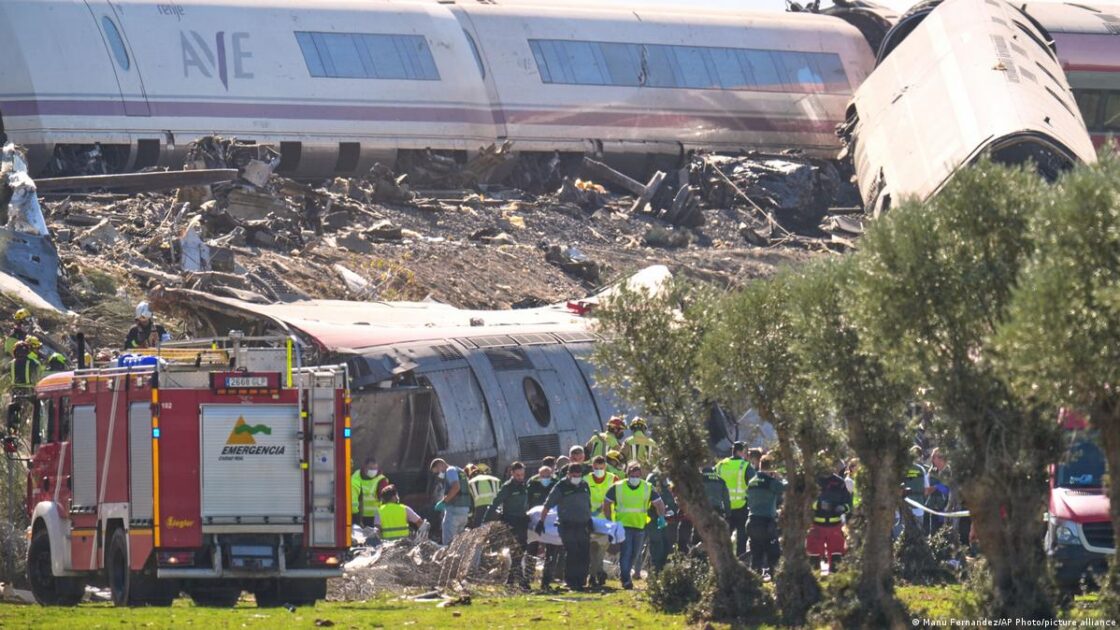
At least 68 people have died and dozens more were injured after two high-speed trains collided near Toledo in central Spain on Wednesday, October 28. The disaster occurred on the high-speed rail line connecting Madrid and Seville, involving a stationary train and another that was instructed to proceed despite a system failure.
Spanish Prime Minister Pedro Sanchez declared three days of official mourning after visiting the crash site near the town of Urda. In a televised address, Sanchez said that all of Spain was in mourning and promised a thorough investigation into the tragedy, which marks the deadliest rail accident in the European Union since 2013.
Operator Error Under Investigation
The collision occurred shortly after 9:00 a.m. between the towns of Mora and Orgaz when a publicly operated Renfe train struck the rear of a stationary, privately operated Iryo train. Local authorities reported that approximately 540 passengers were on board the two services, with 378 on the Renfe train and 147 on the Iryo service.
Spanish Transport Minister Oscar Puente explained during a press conference at the ADIF control center in Madrid that a computer error had disabled the control system along a 63-kilometer stretch of track. The glitch automatically triggered a red stop signal for all trains in the affected area, passing operational control to human dispatchers at ADIF, the state rail infrastructure manager.
Puente described as “inexplicable” the decision by controllers to instruct the Renfe train at 8:36 a.m. to resume its journey as normal despite the active red signal. The train traveled about 25 kilometers at speeds exceeding 100 kilometers per hour before crashing into the back of the stopped Iryo train at 8:53 a.m.
Casualties and Emergency Response
Regional health authorities in Castilla-La Mancha reported that over 100 people were initially hospitalized following the impact, with 18 listed in critical condition. By Wednesday evening, at least 56 patients had been treated and discharged, leaving 53 individuals remaining in care across local hospitals.
European Union flags were lowered to half-mast outside the European Commission headquarters in Brussels as a gesture of solidarity. European Commission President Ursula von der Leyen and EU foreign policy chief Kaja Kallas offered condolences to the victims and their families, while the European Commission stated it stands ready to offer assistance to Spanish authorities.
Spain’s royal family expressed deep sadness over the tragedy. King Felipe VI cut short a military training exercise in Valencia to return to Madrid to monitor the government’s emergency response efforts.
Protests, Sports Postponements, and Rail Context
The tragedy stirred political unrest in the capital, where around 1,500 people attended a protest outside the Transport Ministry organized by far-right groups, according to Spanish broadcaster TVE. Demonstrators demanding the government’s resignation clashed with police, who deployed tear gas to disperse the crowd. Most major political parties temporarily suspended their campaigning for the upcoming November 29 general election, though the far-right Vox party did not.
In response to the tragedy, the Royal Spanish Football Federation suspended over 20 Copa del Rey first-round matches scheduled for Wednesday evening. Major Spanish football clubs, including FC Barcelona and Real Madrid, issued statements expressing sorrow and support for affected families.
Wednesday’s collision marks the second fatal high-speed rail disaster in Spain this year, following a derailment near Cordoba in January that killed 46 people. Railway safety experts note that prior to these incidents, Spain’s high-speed rail network had maintained a clean safety record without fatal crashes since its opening in 1992.