Table of Contents
European Union leaders arrived in Brussels for a crucial showdown over the bloc’s multitrillion-euro, seven-year budget, but the summit quickly unraveled as discussions broke down late on Thursday night. Squabbles and public barbs resulted in leaders leaving without a deal, skipping the planned second day of talks entirely.
Summit Breakdown and Political Drama
While leaders face a self-imposed deadline to reach an agreement before the end of 2026 on the budget covering the 2028-2034 period, experts noted that such friction is common during long-term financial negotiations. Jacob Funk Kirkegaard, an EU economist and expert at the Bruegel think tank in Brussels, told Deutsche Welle: “Every time there are long-term EU budget negotiations, there are breakdowns, chaos, recrimination and a lot of political theater and drama.”
The core of the tension involved the prime ministers of Denmark, Sweden, Belgium, and Austria, who advocate for a reduced budget. These leaders staged a walkout during smaller group meetings, stating the atmosphere was not constructive for securing an agreement. Meanwhile, Hungarian Prime Minister Peter Magyar criticized the summit as completely unnecessary, directing blame toward European Council President Antonio Costa, whose job is to mediate the discussions.
Defending his decision to summon the leaders to Brussels, Costa told the press, as reported by Deutsche Welle: “For me it was very useful to figure out the parameters of a possible landing zone in December.”
Germany Demands Cuts and Ukraine Support
Prior to the summit, Germany issued an ultimatum stating Berlin would only approve the budget if all other EU member states greenlit an additional €45 billion ($49 billion) support loan for Ukraine through 2027. Hungary, Czechia, Bulgaria, and Slovakia opposed the proposal, arguing that funding weapons for Ukraine will prolong the conflict, with Slovak Prime Minister Robert Fico accusing Germany of blackmail.
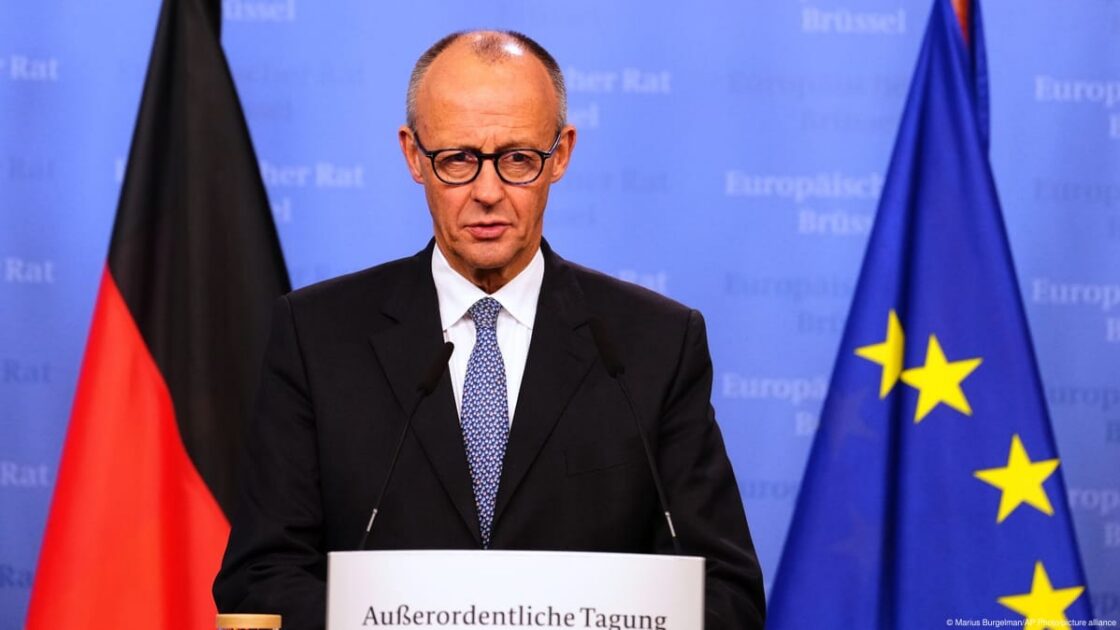
As the bloc’s largest economy, Germany contributes roughly 25% of the total budget. Following the summit, German Chancellor Friedrich Merz stated at a press conference that “hundreds of billions” still need to be cut, noting that the European Commission’s original proposal of roughly €1.786 trillion had already been reduced by €204 billion, or 10.2%. Merz stated that Europe needs a sense of proportion, adding that the budget cannot grow indefinitely and financing burdens must be distributed fairly.
Berlin’s push for reductions is supported by six other net-contributor nations known as the “Sensible Seven.” Conversely, 17 EU member states led by France and Italy form the “Friends of Cohesion,” insisting the overall budget should expand to share wealth with poorer regions. Under the current proposal, spending on agriculture, fisheries, and cohesion decreases from 59.1% to 42.4%, while funding for economic competitiveness, security, and defense rises from 17.7% to 27.7%, fulfilling a key German demand.
Digital Tax Proposals and Credit Rating Concerns
The EU is also exploring revenue streams independent of national contributions, including a controversial digital tax that could spark friction with the United States. Proposed by French President Emmanuel Macron, the measure involves a 3% tax on revenues from online advertising, online marketplaces, and user data monetization, aiming to raise €5 billion annually for the EU budget.
The proposal concerns Ireland, where major US tech companies like Google, Meta, Apple, Microsoft, and LinkedIn are based. Irish Prime Minister Micheal Martin, who retains veto power, stated that a digital tax sends incorrect messages. Furthermore, Cristina Enache, an economist at the Tax Foundation Europe, told Deutsche Welle that economic costs outweigh generated revenue based on prior examples, calling the proposal politically impossible.
Concerns also persist regarding the European Commission’s triple-A credit rating, which faces potential downgrades if the EU cannot generate independent funds while holding roughly €860 billion in outstanding pandemic recovery and Ukraine support debts. Kirkegaard noted that net-contributing countries like Germany, the Nordics, and the Dutch are more open to alternative financing models to prevent rising interest rate costs should the credit rating drop.
EU leaders are scheduled to return to the conference rooms in late December to resume negotiations ahead of the end-2026 deadline.