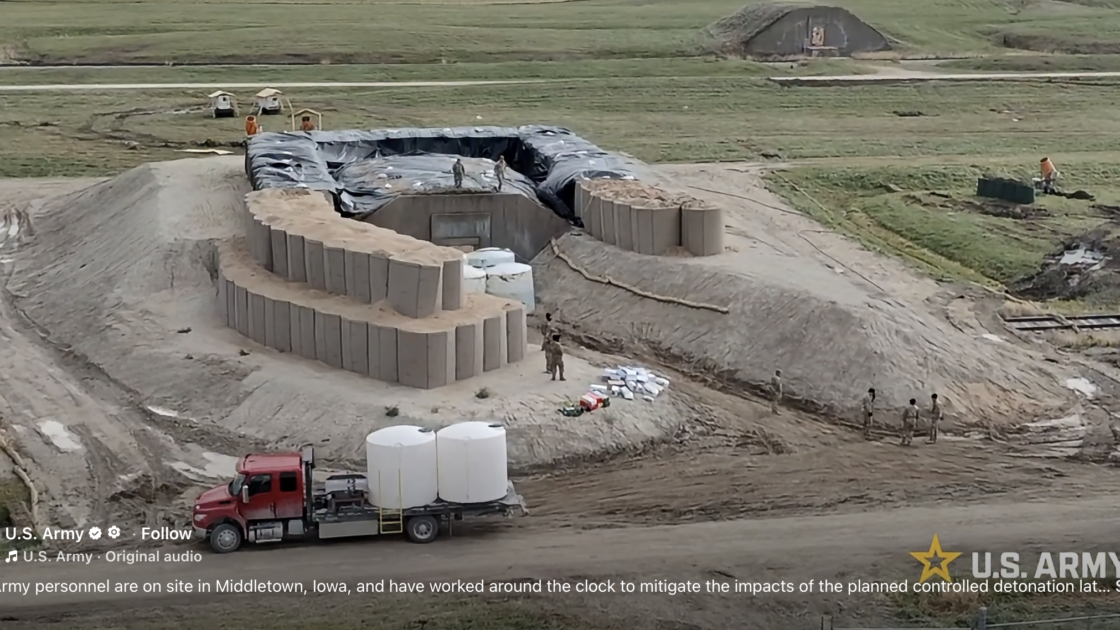
The U.S. Army successfully detonated 68 barrels containing 9,700 pounds of degraded lead azide at the Iowa Army Ammunition Plant on Wednesday morning. The controlled blast, which generated large gray-white clouds over southeastern Iowa, was executed to prevent a dangerous spontaneous explosion of the unstable chemical compound.
Evacuations and Safety Protocols
The detonation took place at the military facility in Middletown, a small community of fewer than 400 residents. Authorities instructed individuals living within a five-mile radius of the site to evacuate. Meanwhile, residents located further away were ordered to shelter in place, secure their doors and windows, turn off all fans, and adjust indoor climate systems to recirculate air.
Local news station KWQC captured the massive smoke plume erupting from two earth-covered containers that were blown up at the same time. According to KWQC reporting, a journalist positioned at a safe distance from the site witnessed and felt the shockwave travel across a nearby crop field, prompting the reporter to wear a mask for the remainder of the live broadcast.
Health Risks and Environmental Monitoring
Lead is a potent neurotoxin that persists in the environment indefinitely, presenting serious health hazards, especially for pregnant individuals and young children. Prior to the operation, the military published predictive maps detailing the projected trajectory and dispersal of the smoke plume. Projections showed that airborne lead particles would drift approximately 100 miles southwest, with falling dust affecting an area of roughly 200 square miles.
Government employees and researchers have already gathered air and soil specimens from the affected region. These samples will serve as reference baseline measurements to track lead concentrations following the blast fallout.