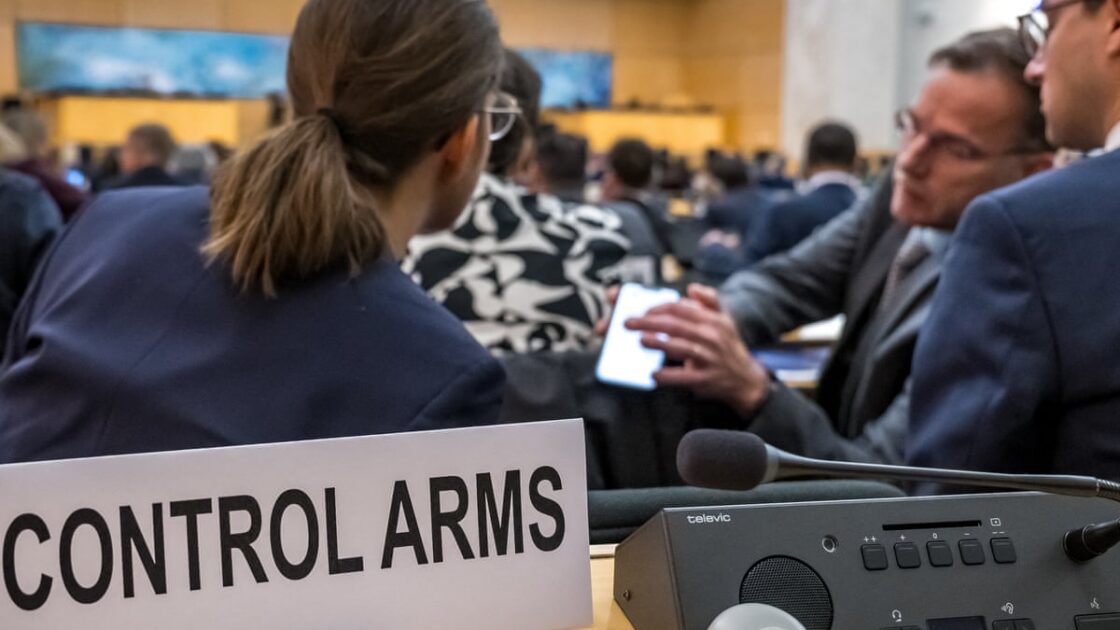
Week-long efforts to agree on a negotiating mandate for a legally binding international treaty to control autonomous weapons collapsed just before 5 am in Geneva. The all-night talks failed to overcome objections from Russia.
Negotiations and Objections
Despite an overwhelming majority of states at the UN’s Convention on Certain Conventional Weapons (CCW) wanting to establish a negotiating mandate leading to a legally binding treaty, the forum’s consensus requirement forced the conference to adopt a much weaker option. The resulting mandate asked countries to elaborate by consensus an instrument that may not carry any legal obligations. Although Russia led the objections using obstructive stalling tactics, other military powers invested in artificial intelligence warfare, such as the United States, were reluctant to commit to a legally binding protocol protecting civilians from robot drones and other autonomous weapons.
Some countries argued that existing international humanitarian law was sufficient. More than 100 states had been pushing for a new law, stating that the weapons raised entirely new challenges. European and NATO states, including Ukraine, China, and Iran, expressed support or willingness for a new protocol. Meanwhile, South Korea, Japan, Turkey, the UK, France, and Germany were among the defense tech powers exploring AI-enabled weapons that expressed resistance to being bound by a new law, instead advocating for a nonbinding agreement. The US stated that the need for human control over autonomous weapons had been discussed at the APEC summit in meetings between President Xi Jinping and Donald Trump, but remained reluctant to agree to a binding treaty.
The CCW operates via consensus, meaning all 128 parties to the convention must agree unanimously to pass a statement. This high threshold has resulted in the CCW failing to pass any new laws regulating weapons in the past 30 years, leading states to seek pathways elsewhere, such as the 2008 ban on cluster munitions. Diplomats inside the negotiations reported that Russia had been deliberately filibustering and not working in good faith, in contrast to US delegates who had been seeking a path to reach a consensus statement. Additionally, the exclusion of several nonmember countries from negotiations prompted a rare protest on the final day, with the Egyptian delegation shouting at the conference chair.
Reactions and Future Concerns
Max Tegmark, chair of the Future of Life Institute, stated that world leaders had failed to meet the moment. He noted that autonomous slaughterbots are already present, yet states agreed it is sufficient to only talk about the issue for the 14th year. Critics pointed out that states had been discussing autonomous weapons, their dangers, and the need for international rules for 13 years, with large substantive parts of a treaty already settled. A European diplomat noted that there was a lack of political will to truly regulate the weapons in a way that matched the urgency.
Bonnie Docherty, a senior arms adviser at Human Rights Watch who was directly involved in previously successful treaties banning cluster munitions and nuclear weapons, stated that autonomous weapons require binding law. She noted that treaties could be negotiated within 15 months and dismissed the US proposal of five years to sort out a mandate. A bloc of seven countries consisting of Austria, Belgium, Brazil, Ireland, Mexico, New Zealand, and Panama had led the push for a binding treaty to be negotiated within one year. On Wednesday, the Brazilian delegate told the floor that these are not weapons of the future, but are already in use and being further developed, adding that nations are late in developing norms and rules to regulate these lethal autonomous systems.
Israel and the US have utilized AI-enabled targeting systems to conduct tens of thousands of strikes in Gaza and Iran, resulting in mass casualties. The Pentagon struck more than 1,000 targets in Iran on the first day of the war, and investigative media reports indicate the US military is aiming to carry out 1,000 AI-assisted targeting decisions per hour.