Table of Contents
European leaders have stated their readiness for negotiations with Russia to end the war in Ukraine during a summit in Berlin. UK Prime Minister Andy Burnham and German Chancellor Friedrich Merz emphasized unity and realistic demands as US envoys reported potential progress following talks in China.
Berlin Summit and US Envoys
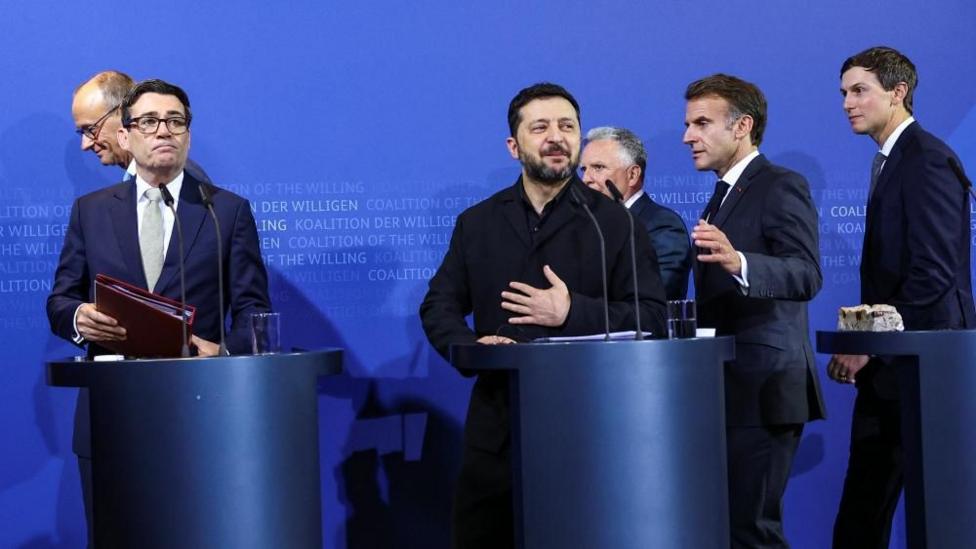
Speaking at the Coalition of the Willing summit of Ukraine’s allies in Berlin, UK Prime Minister Andy Burnham told BBC News that Europe maintains a clear, consistent, and united negotiating position. German Chancellor Friedrich Merz stressed that Moscow’s maximalist demands remain unrealistic. Donald Trump’s son-in-law Jared Kushner, one of two US envoys present in Berlin, stated that US President Donald Trump wanted to make a deal with Moscow with Europe alongside him. Meanwhile, Russian President Vladimir Putin has previously rejected any European role in US-led peace talks.
Donald Trump earlier held trilateral talks in Shenzhen, south-eastern China, with Putin and Chinese President Xi Jinping, later dialing into the Berlin summit from Air Force One. During a press conference following those talks, Putin stated that Americans were insistently asking Russia to allow European participation. Putin claimed Russia was not opposed to the idea but wanted to clarify what Europe would bring to the talks. Consequently, Moscow invited Europeans to visit Moscow through diplomatic channels to determine their positions before deciding on the dialogue format with Ukraine.
Putin criticized European leaders for constantly discussing an impending war in 2030, stating that Russia has no plans to attack anyone and questioning the normalcy of such rhetoric. Nevertheless, Putin acknowledged that discussing European security issues without Europeans is pointless. Jared Kushner reported to reporters that the US president left Shenzhen believing peace is achievable. Kushner added that Russians were willing to trust US envoys’ instincts regarding European participation at the table and that Moscow felt comfortable with Ukraine receiving security guarantees modeled on NATO’s Article Five, requiring allies to defend an attacked nation.
Skepticism from European Leaders and Ukraine
Ukrainian President Volodymyr Zelensky, attending the Berlin summit, has long sought an equivalent to NATO’s collective defense clause, though indications of Putin accepting such conditions remain scarce. While Russia outright rejects Ukrainian membership in NATO, US negotiators have reportedly considered Article Five-style guarantees outside the defensive alliance in exchange for painful territorial concessions. Zelensky and European leaders Merz, Burnham, and French President Emmanuel Macron expressed less optimism than Kushner, with Zelensky noting that Putin has consistently rejected every proposal.
German Chancellor Friedrich Merz expressed skepticism while noting that US involvement increases peace prospects. Merz stated that Europe is willing to enter serious discussions on European security with Russia provided it matches a serious discussion and a primary peace agreement with Ukraine. Merz rejected any attempts to divide Europe into spheres of influence run by major powers, criticizing the Shenzhen summit as primarily a photo opportunity and stating that a Yalta format will not bring peace. Polish Prime Minister Donald Tusk also objected to Trump describing Putin as a friend during the Shenzhen summit, declaring that Putin is not a friend and never will be.
French President Emmanuel Macron urged allies to maximize efforts to deliver necessary air defence systems for Ukraine to repel deadly Russian attacks and asked allies to reopen the question of Ukrainian NATO membership. Mixed messages have emerged from Moscow regarding European participation. While US envoys Steve Witkoff and Kushner indicated last week that Europe would soon join the negotiating table, Putin’s aide Yury Ushakov stated that a great deal of work remains before expanding the format.
Ongoing Conflict and Moscow’s Stance
Russia launched its full-scale invasion of Ukraine in February 2022. Despite engagement in several rounds of talks over the past year, Kremlin rhetoric and actions show no indication of scaling down the war. Russia continues targeting Kyiv’s energy infrastructure as winter sets in, resulting in rising civilian casualties while maintaining demands for Ukrainian sovereign territory. During delegations’ meetings in China and Germany, drone attacks struck Kyiv’s historic centre, killing one person in a residential building in the Podilskyi neighbourhood and damaging the Dutch and Austrian embassies as well as Saint Volodymyr’s Cathedral.
Putin vowed that Moscow’s response to a Ukrainian strike on the Crimean Bridge linking Russia with occupied Crimea would be considerably more painful than Kyiv’s actions. He mentioned discussing a possible ceasefire in several areas before abandoning the idea following the bridge attack. Putin claimed to be interested in ending the war and ready to compromise, while asserting that Ukraine and Europe are not. He stated a complete lack of desire to continue the armed conflict, despite intensified recent attacks on critical infrastructure as cold weather approaches. Kyiv and its European allies maintain that the Kremlin leader aims to break Ukrainian resistance by depriving millions of civilians of electricity and water.