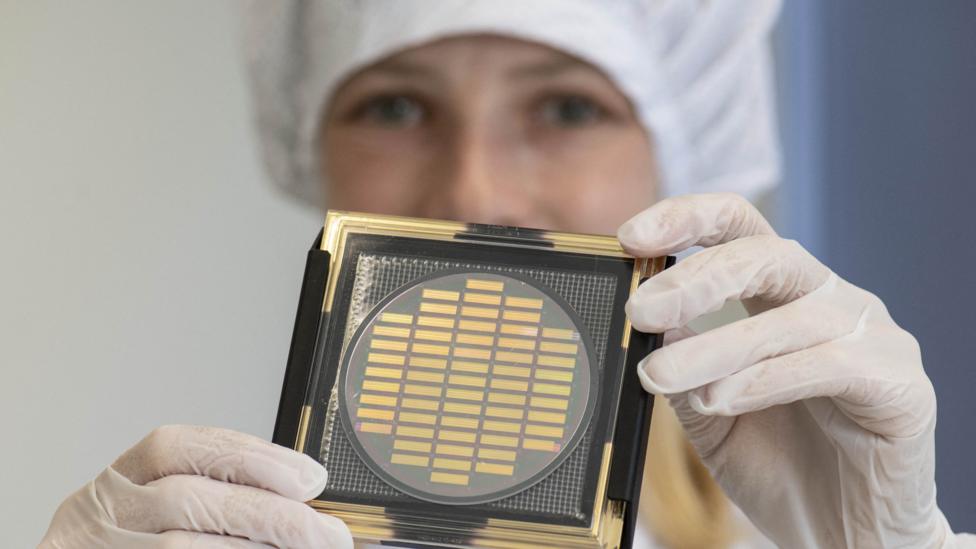
Europe is heavily investing in photonic chips, a breakthrough technology that uses light instead of electricity to process data faster while consuming less energy and generating less heat. With backing from the European Union and the Dutch government, researchers hope this initiative will help the continent secure a leading position in the next wave of computer chip development.
The Promise of Photonics
Traditional computer chips used in phones, televisions, and massive artificial intelligence data centres are electrical, processing information by moving electrons across tiny circuits containing billions of transistors. According to Ton van Mol of the Dutch research institute TNO, optical chips currently sit at a developmental stage comparable to where electronic chips were 40 or 50 years ago. To capture this emerging market, the European Union has committed €400 million to a project named PIX Europe, aiming to establish the continent as a global leader in Photonic Integrated Chips.
Van Mol explained that Europe must establish in-house manufacturing rather than relying entirely on production in the United States or China. This strategy aligns with the European Chips Act, which funds pilot lines to transition laboratory technology into large-scale manufacturing. While global photonic chip production currently relies on four-inch wafers, TNO’s team is constructing a 10,000-square-metre facility in Eindhoven, the Netherlands, to manufacture six-inch indium phosphide wafers. Scheduled to fully open in 2030, the facility intends to offer a stable, high-yield process before opening to industrial partners for commercial production.
Building an Industrial Ecosystem
The Eindhoven project benefits from its proximity to ASML, a dominant Netherlands-based tech giant that builds the world’s most advanced semiconductor manufacturing machines. Stanislas Baron, head of ASML’s EU/US Customer Team, noted that Europe holds a strong position in photonics research and faces the subsequent challenge of translating those innovations into industrial-scale production. The initiative also receives support from former ASML chief executive Peter Wennink, who authored a government report highlighting that the photonics market is projected to grow tenfold or twentyfold over the next decade.
Global competition in the sector is intensifying. In June, American photonics firm Coherent announced a large-scale six-inch indium phosphide manufacturing platform in Texas, backed by Nvidia and public funds under the US Chips Act. Joris Teer, a policy analyst at the European Institute for Security Studies in Brussels, stated that while full reindustrialisation is unfeasible for Europe due to high costs and labour shortages, securing mutual dependence on European technology is vital to maintaining global influence.
Once operational, the Eindhoven facility will operate on a foundry model, producing chips to order for external companies across Europe and beyond, allowing businesses to design hardware without building costly private facilities. Although photonic chips currently serve specialized applications like data centres and Lidar sensors, van Mol emphasized that scaling up production is the critical step toward integrating them into everyday consumer devices such as phones and laptops, as well as advancing medical scanners and 6G communications.